PVT Retrofit for Existing Heat Pump Systems

Solar PVT collectors designed for existing air source heat pumps, domestic hot water pre-heating and renewable heating retrofit applications. 

PVT technology combines photovoltaic electricity generation with low-temperature thermal collection in a single roof-mounted system. In retrofit applications, PVT collectors can support existing heat pump systems by contributing renewable thermal energy for pre-heating, hybrid heating concepts and improved overall energy utilization. An air source heat pump’s efficiency drops in cold weather — exactly when heating demand is highest. Adding PVT panels to an existing ASHP raises the effective heat source temperature, reduces the system’s electricity draw, and generates on-site power from the same roof area. No replacement of the existing heat pump required.

Suitable for:

  • Existing air source heat pumps
  • Domestic hot water pre-heating
  • Renewable retrofit projects
  • Hybrid heating systems
  • Pool heating support
  • Low-temperature thermal applications
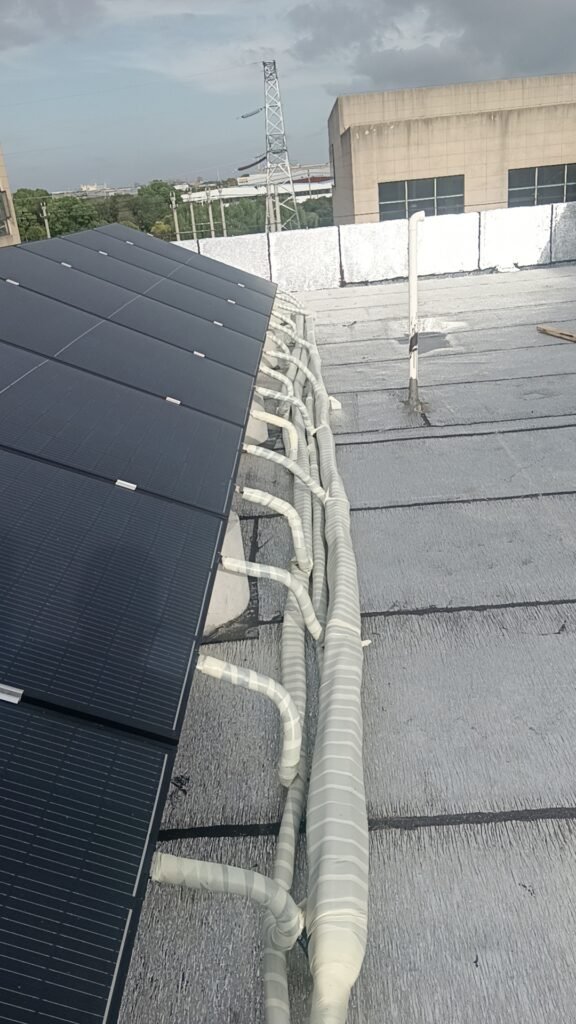
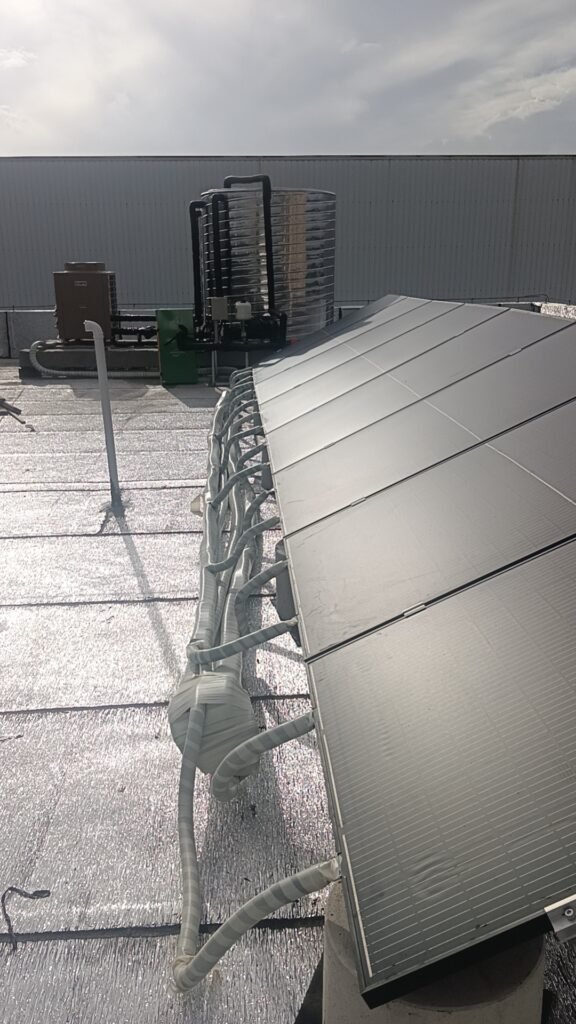
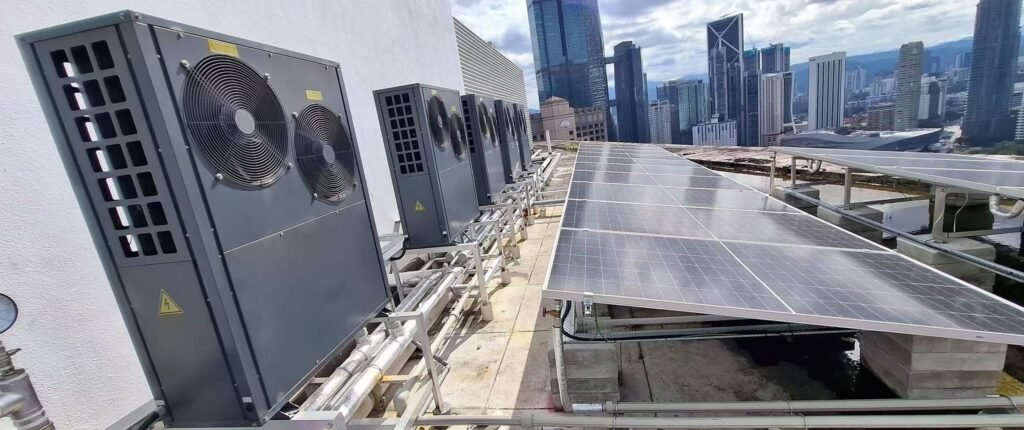
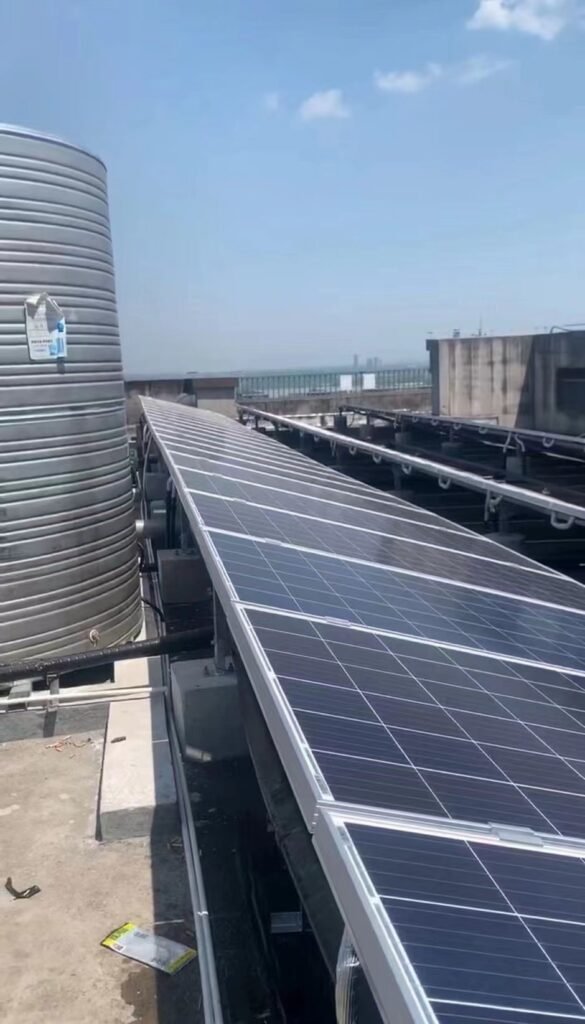
PVT solar panels with heat pump system on office building rooftop providing hot water supply
up to 52%
COP improvement vs ASHP alone at low ambient temperature
ScienceDirect / Pusan National University, 2023
15–25%
Typical seasonal running cost reduction for DHW pre-heating
Applied Energy, system-level analysis
44%
Lower initial cost vs PVT + ground source heat pump
ScienceDirect, 2023 — PVT-ASHP vs PVT-GSHP comparison
0
Heat pump replacements needed — connects to existing ASHP
The air source efficiency problem

Why ASHP efficiency falls in winter — and what PVT does about it

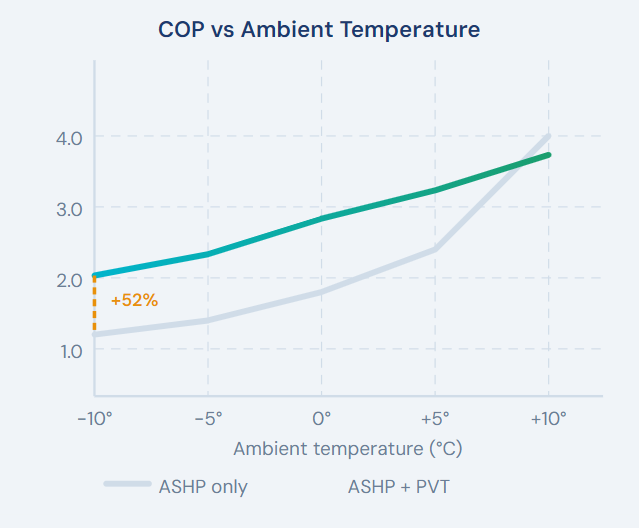
An air source heat pump extracts heat from outdoor air. When ambient temperature falls, the air contains less thermal energy per cubic metre, the compressor has to work harder to maintain output temperature, and COP drops. A modern ASHP rated at COP 4.0 at +7 °C ambient may deliver COP 2.2 at −5 °C — the point in winter when it is needed most.

A PVT panel provides a parallel thermal input that partially compensates for this cold-weather efficiency loss. The panel’s rear absorber delivers solar and sky-radiation heat at temperatures that are 2–10 °C above ambient even in winter — a meaningful uplift at exactly the operating point where the ASHP struggles. The same panel simultaneously generates electricity, which offsets part of the compressor’s power draw.

Critically, this is a retrofit upgrade. PVT panels can be added to any existing ASHP installation without replacing the outdoor unit, heat pump module, or existing hydraulics. Connection takes one of three standard forms depending on the existing system layout and the owner’s priorities.

6e0b743f0aafb5d053df447e02a499cb

Illustrative COP curves. Largest PVT benefit occurs at low ambient temperatures — precisely where ASHP efficiency is weakest. Sources: ScienceDirect PVT-ASHP study, 2023.

System integration

Three ways to connect PVT panels to an existing ASHP

The right connection method depends on the existing system layout and the owner’s primary goal — reducing DHW cost, improving heating COP, or extending pool season. All three work with standard ASHP installations and require no modification to the heat pump refrigerant circuit.

DHW solar pre-heat tank
Most common retrofit · reduces heat pump DHW energy draw

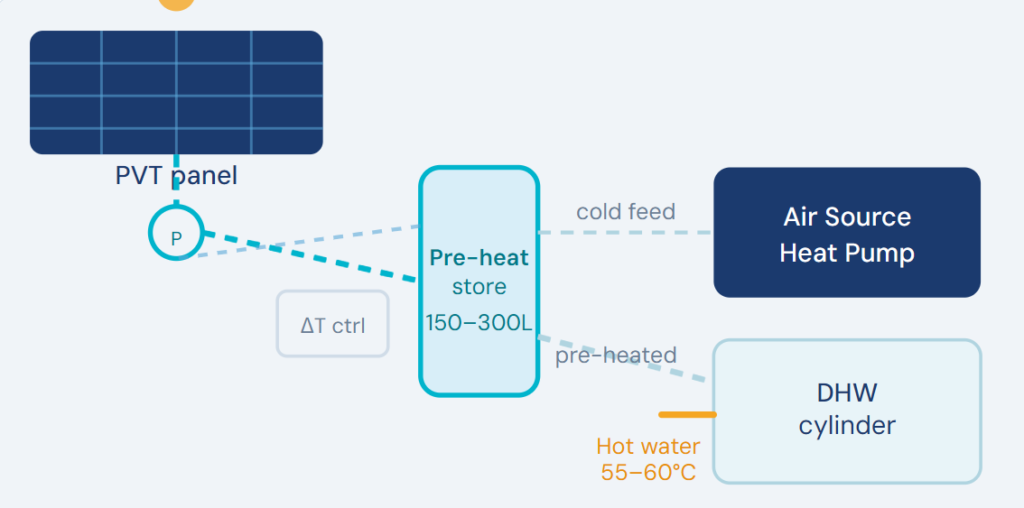
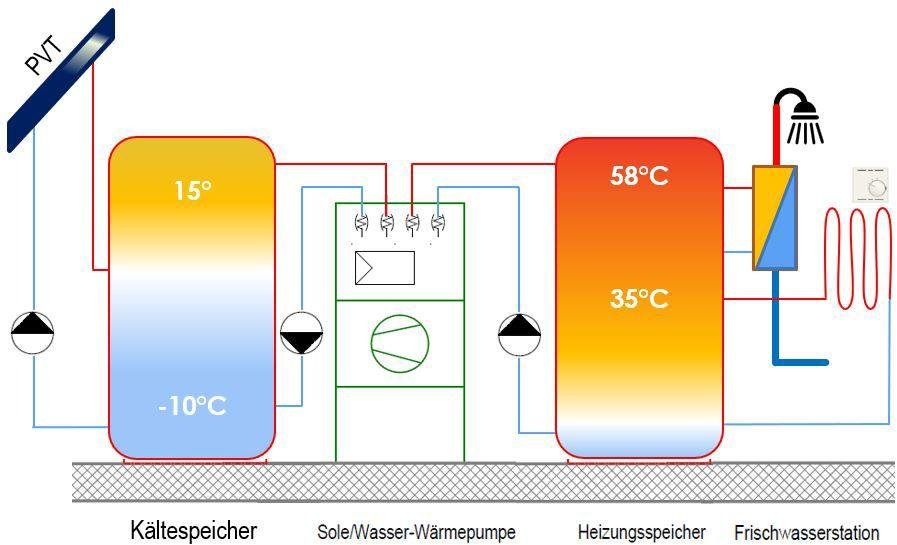
A solar pre-heat store — typically 150–300 litres — is inserted between the cold mains feed and the heat pump’s domestic hot water cylinder. PVT panels heat this store whenever absorber temperature exceeds the tank temperature by a set differential (usually 5–8 K), controlled by a standard differential temperature controller.

The pre-heated water reduces the temperature lift the heat pump must achieve for DHW production. If the tank reaches 45–50 °C on a good solar day, the heat pump’s DHW cycle may not activate at all — delivering direct solar displacement of heat pump electricity. On partial solar days, the pre-heat reduces the heat pump’s required run time.

Best for: households with significant DHW demand (3+ occupants), east/west split roofs where full south orientation is not available, or any installation where the primary goal is reducing energy bills rather than improving space heating performance.

Suitable for:

  • Existing tanks
  • Residential retrofit
  • Renewable hot water upgrades
  • Low-temperature thermal support
72b5a45a1d7778618679a3a127b7f787

Method 1: PVT → differential controller → circulating pump → solar pre-heat store → cold feed to ASHP DHW cylinder. Reduces heat pump DHW run time proportionally to solar yield.

Solar-direct heating · heat pump bypass when solar sufficient. Pool heating & low-temperature circuits

For pool heating or low-temperature underfloor circuits, PVT brine connects to a plate heat exchanger in the pool or heating circuit. A priority valve diverts brine to the pool when solar gain is available, bypassing the heat pump entirely. The ASHP only operates when brine temperature is insufficient to meet the circuit’s set point — typically below 25–28 °C for pools or below 30–35 °C for low-temperature underfloor systems.

For outdoor pools in Northern and Central Europe, this configuration can extend the swimming season by 6–8 weeks in spring and autumn, with the heat pump covering early-season and late-season shortfall. The PVT absorber operates effectively at pool temperatures of 22–30 °C — well within its productive thermal output range. 

  • Suitable for:

    • Multi-source heating systems
    • Existing renewable projects
    • Pool heating support
    • Seasonal thermal applications

Pool heating — season extension in practice

A 6 × 3 m pool (18 m³) in Central Europe requires approximately 8–12 m² of PVT panel area to extend the season from June–August to April–October. The heat pump handles early-season heating from May water temperature; PVT covers the majority of the June–September thermal load. Pool filtration electricity is offset by PV output from the same panels.

Highest COP gain · raises effective source temperature in winter. Evaporator-side thermal assist

PVT brine circulates through a supplementary heat exchanger coil located at the ASHP outdoor unit’s air intake, or via a dedicated brine-to-refrigerant heat exchanger on the low-pressure side of the refrigerant circuit. The warm brine raises the effective evaporation temperature, allowing the compressor to operate at a higher suction pressure — directly improving COP.

This is where the largest performance gains are measured. Research shows COP improvement of up to 52% at low ambient temperatures compared to the same ASHP without PVT assist — the benefit is largest precisely when ambient air is coldest and ASHP efficiency is lowest.

Best for: installations in cold climates (Northern Europe, high altitude) where the ASHP shows significant COP degradation below −5 °C, or where the building has high space heating demand and DHW pre-heating alone cannot achieve meaningful running cost reduction.

Suitable for:

  • Existing air source heat pumps
  • Hybrid heating concepts
  • Renewable energy upgrades
  • Improved roof energy utilization

Installation note

Evaporator-side connection requires a supplementary heat exchanger coil compatible with the specific ASHP outdoor unit. We supply technical data sheets and brine circuit specifications to support your installer’s design. Connection method and glycol concentration must be verified against the heat pump manufacturer’s brine specification.

Why Add PVT to an Existing Heat Pump System?

Many residential and small commercial buildings already use air source heat pumps for heating and domestic hot water production. PVT collectors can be integrated as an additional renewable thermal source without requiring a complete system replacement.

This makes PVT increasingly relevant in retrofit and energy upgrade projects.

Additional Renewable Energy Input

Provide low-temperature thermal energy alongside photovoltaic electricity generation.

Roof Space Optimization

Generate electricity and collect thermal energy within the same installation footprint.

Domestic Hot Water Pre-Heating

Support hot water systems using renewable thermal input before heat pump operation.

Hybrid Heating Possibilities

Suitable for integration into selected hybrid renewable heating concepts.

Retrofit Flexibility

Can be considered in existing heating projects without complete system replacement.

Improved Energy Utilization

Increase renewable energy contribution within existing buildings.

Typical PVT Retrofit Applications

30s9udexkef9oz1fcwpbdzofxfcbqe qovzmtgvjxztsgvuiztsqv4xhaklmfnrgjvfov2xw3lscbb9dbuofy3wl8dqgo 9gjv5e93itdhjkbtlnm2gv6ylv70lgdg4dbuiyxe88kl1fhv 7pyvgabzpxvnblq56ela1xcjo ilagppbptw4uiqhjswqqmrt

Existing Air Source Heat Pump Systems

Domestic hot water accounts for 25–40% of heat pump electricity consumption in typical European homes. Adding 6–10 m² of PVT for DHW pre-heating delivers measurable seasonal savings without touching the heating circuit. The payback period is often shorter than full system upgrades because the solar store integrates into the existing hot water plumbing.

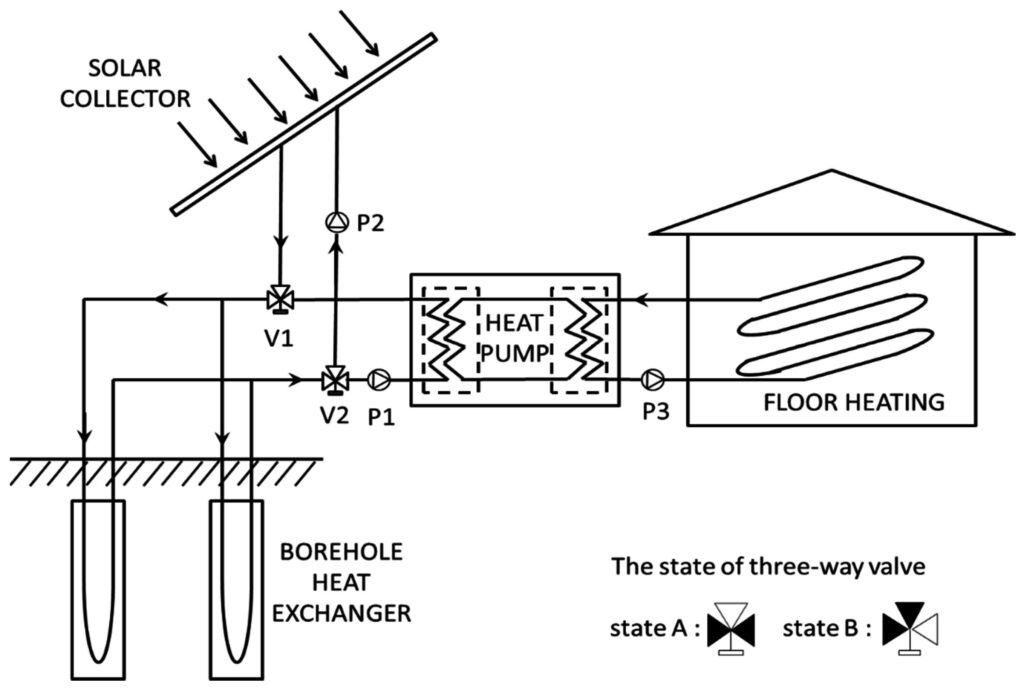
PVT collectors can support existing air source heat pump systems by providing renewable thermal input for selected low-temperature applications.

Typical retrofit concepts include:

  • Source-side thermal support
  • Renewable heating upgrades
  • Hybrid heating integration
  • Existing tank pre-heating
  • Seasonal energy optimization

In many retrofit projects, PVT systems are used as an additional renewable energy layer rather than a complete heating replacement.
Domestic Hot Water Pre-Heating

One of the most common retrofit applications involves using PVT collectors to pre-heat domestic hot water before the heat pump or electric backup system operates.

Typical advantages include:

  • Reduced water heating demand
  • Increased renewable contribution
  • Improved self-consumption potential
  • Better use of available roof area

This concept is increasingly explored in residential renewable retrofit projects.

soliswatt pvt (2)
be7579gqk2lbrm9amughthk9tgt2yad5piwsu6jjowkpoec ywxyyva6vnc1rfnss4pa4zbpkittwo5ko4ztzktbwtsl4oib17xddoz8pazvicl7pbdscg4rsbxtsasugumjyzqghx7ktvn7e0scoq7ioitrtdy exix86gximlfqftcztjdpgodqz6ycjve

Hybrid Renewable Heating Systems

PVT collectors can also be integrated into hybrid renewable heating systems where multiple energy sources operate together.

Typical configurations include:

  • Existing ASHP + PVT
  • PVT + thermal storage
  • Renewable retrofit upgrades
  • Low-temperature heating systems

Hybrid retrofit concepts are increasingly discussed in European renewable heating projects where maximizing roof energy utilization is important.

Pool Heating & Seasonal Heating Support

PVT collectors can contribute low-temperature thermal energy for swimming pool heating and seasonal thermal support applications.

Typical scenarios include:

  • Residential pools
  • Hotel pool systems
  • Summer heating demand
  • Renewable energy upgrades

Pool heating is often suitable for low-temperature renewable thermal collection concepts.

PVT-supported geothermal systems are increasingly considered in residential renewable heating projects where roof energy utilization and seasonal efficiency are important.

Typical applications include:

  • Single-family homes
  • Low-energy buildings
  • Rural geothermal projects
  • Hybrid renewable heating systems
dauryta4fn 4 kpbx5gxkps ppiqwr1lphys2sgiwhavupkkwhke0mpx9atdjab efnpefq u95vpatqeknjjca7mf5sb1 l k59wjee7lwikfgipmjcb77q y6c au6hmdzwzefayhibfxkj1of4kdf0 omnvyerrqlpat0aavq3wzz3ffkvabjxlknfz 5
Applications

Which existing ASHP installations benefit most

Existing ASHP with high DHW demand — households of 3 or more

Domestic hot water accounts for 25–40% of heat pump electricity consumption in typical European homes. Adding 6–10 m² of PVT for DHW pre-heating delivers measurable seasonal savings without touching the heating circuit. The payback period is often shorter than full system upgrades because the solar store integrates into the existing hot water plumbing.

Cold climate ASHP installations — Scandinavia, Baltic, Alpine

At ambient temperatures below −5 °C, air source heat pump COP falls to 2.0–2.4 in most products. PVT thermal assist raises the effective source temperature, recovering 0.5–1.5 COP points at exactly this operating condition. For properties in Northern Europe spending 3–4 months below −5 °C, the seasonal electricity saving is proportionally significant.

Properties where ASHP was installed to replace gas — energy bill reduction priority

Many post-2020 ASHP installations in Europe replaced gas boilers under subsidy programmes. Owners often find winter electricity bills higher than expected. PVT adds solar DHW pre-heat and partial space heating assist — reducing the heat pump’s grid electricity draw through the two mechanisms simultaneously: less thermal work required, and PV output covering part of the compressor load.

Homes with pools or summer DHW peak demand — solar-direct bypass

Properties with outdoor pools or high summer hot water use benefit from solar-direct operation. When PVT absorber temperature exceeds the circuit set point, the heat pump bypasses entirely and brine delivers heat directly to the pool or DHW store. On clear summer days this eliminates heat pump electricity consumption for hours at a time.

What the research shows

Published performance data on PVT + ASHP systems

The figures below are drawn from peer-reviewed research on integrated PVT-ASHP systems. They represent measured or modelled system-level outcomes, not panel-level specifications.

Key research findings

52%

Maximum COP improvement of PVT-ASHP over a standalone ASHP system, measured in an integrated zero-energy building test installation. Average heating COP of the combined system reached 3.54 — compared to 2.33 for the ASHP alone at comparable conditions.

ScienceDirect — Pusan National University experimental study, published 2023

18%

PVT module offset of total system power consumption during winter operation in the same study, rising to 27% in summer when solar irradiance is higher and DHW or cooling demand increases.

ScienceDirect, 2023 — PVT-ASHP integrated system for zero-energy buildings

4.1

Average COP achieved by a PVT-ASHP integrated system in Italian experimental conditions, demonstrating effective COP improvement at low outdoor temperatures where conventional ASHP would otherwise deliver COP 2.0–2.5.

ScienceDirect — Italian experimental PVT-ASHP analysis, peer-reviewed

44%

Reduction in initial system cost of PVT-ASHP versus a PVT-GSHP system achieving comparable annual energy performance. PVT-ASHP heating COP differed from PVT-GSHP by less than 9% — making the ASHP retrofit economically dominant for most residential projects.

ScienceDirect, 2023 — comparative techno-economic analysis

All values are from published research on specific system configurations. Actual results depend on climate, existing ASHP model, connection method, roof orientation, and system sizing. Site-specific performance estimates are available on request.

Technology comparison

PVT-assisted ASHP vs other upgrade paths

For homeowners and installers evaluating options for upgrading an underperforming ASHP, PVT addition offers a lower-cost, lower-disruption path than replacing the heat pump or switching to a ground source system.

CriterionASHP onlyReplace ASHP with GSHPASHP + PVT (this system)
Existing heat pump retainedYesNo — full replacementYes — no replacement
Ground works requiredNoneYes — borehole or trenchingNone — roof only
Winter COP improvementNoneHigh (GSHP source temp stable)Medium — 15–52% depending on config
On-site electricity generationNoNo (unless separate PV added)Yes — PV from same panel
DHW solar pre-heatingNoNoYes — solar store option
Pool / low-temp heatingVia heat pump onlyVia heat pump onlySolar-direct bypass option
Upfront cost relative to ASHP aloneBaselineHigh (new HP + drilling)Panels + solar store only
Product

PVT brine collector — specification for ASHP integration

The panel used for ASHP pre-heating applications is our insulated brine PVT collector: a standard crystalline silicon PV module with a stainless-steel serpentine absorber bonded to the rear face, backed by a mineral wool insulation layer. The insulation layer keeps absorbed heat in the brine circuit rather than losing it to the back of the panel.

For DHW pre-heating, the brine circuit connects to a dedicated solar store via a differential temperature controller and small circulating pump — identical to a conventional solar thermal installation, but with PV electricity generation added from the front face. For evaporator assist, the brine circuit connects to a supplementary coil at the outdoor unit.

ParameterValue
Absorber typeStainless-steel serpentine, rear-bonded
Heat transfer fluidPropylene-glycol / water (30–40%)
Operating temp range−15 °C to +70 °C (brine circuit)
Rear insulationMineral wool, rear face
PV cell typeCrystalline silicon (standard module)
Typical DHW brine temp+20 °C to +55 °C (conditions dependent)
Brine connection22 mm or 28 mm compression
FrameAnodised aluminium
MountingStandard roof hooks or ballast frame
Controller typeStandard differential temperature controller (5–8 K ΔT)
Design guidance

How much PVT panel area does an ASHP retrofit need?

Panel area depends primarily on the connection method and the load being served.

For DHW pre-heating, 4–8 m² of PVT (1–2 panels) serves a 3–4 person household in Central Europe, covering 40–60% of DHW thermal load in an annual average. A 200–300 litre solar pre-heat store is typically paired with this area.

For evaporator thermal assist, 6–14 m² of PVT provides meaningful source temperature uplift for a 6–12 kW ASHP. Sizing depends on the heat pump’s rated source inlet temperature and flow rate requirements.

For pool heating, 0.5–0.8 m² of PVT per m³ of pool volume is a starting point for Central European climates — a 20 m³ pool requires 10–16 m² of PVT to achieve meaningful season extension without the heat pump running continuously.

ApplicationTypical PVT area
DHW pre-heat (3–4 persons)4–8 m² (1–2 panels)
DHW pre-heat (5–6 persons)8–12 m² (2–3 panels)
Evaporator assist — 6 kW ASHP6–10 m² (2–3 panels)
Evaporator assist — 10 kW ASHP10–16 m² (3–5 panels)
Pool heating — 15 m³8–12 m² (2–3 panels)
Pool heating — 30 m³15–24 m² (4–7 panels)
Combined DHW + pool12–20 m² (4–6 panels)

Indicative values for Central/Northern Europe, south-facing 30–45° tilt. East/west split or flat roof installations require 10–20% larger array. Actual sizing provided on a project basis.

微信图片 20241226163222

Hotels

Power your hotel with clean, efficient energy

微信图片 20241226163220

Hospitals

Reliable, efficient energy for critical care

spvt (6)

Industrial hot water systems

Hotels, offices, schools, industrial,food processing,hospitals,breweries. Slash industrial energy bills with PVT

Frequently Asked Questions

Yes. PVT systems can be considered in selected retrofit projects involving existing ASHP installations.

A PVT retrofit system integrates photovoltaic-thermal collectors into an existing heating installation to provide additional renewable energy input.

Yes. PVT collectors are increasingly explored for domestic hot water pre-heating applications.

In most retrofit projects, PVT operates as an additional renewable energy source rather than replacing the original system.

PVT combines electricity generation and thermal collection within the same roof area, increasing overall roof energy utilization.

Standard PV modules generate electricity only, while PVT collectors generate both electricity and thermal energy.

Yes. Low-temperature thermal collection can be suitable for pool heating support applications.

Yes. PVT is commonly associated with low-temperature renewable heating concepts.

Yes. PVT systems are designed to produce photovoltaic electricity and usable thermal energy within the same collector structure.

For DHW pre-heat connection (Method 1), PVT works with any ASHP that uses a hot water cylinder or buffer tank — the solar store simply connects on the cold feed side using standard plumbing. For evaporator-side assist (Method 2), compatibility depends on the specific outdoor unit design and whether a supplementary coil or heat exchanger can be fitted at the evaporator. We supply technical data sheets to support your installer’s assessment of a specific model.

For DHW pre-heat connection (Method 1), PVT works with any ASHP that uses a hot water cylinder or buffer tank — the solar store simply connects on the cold feed side using standard plumbing. For evaporator-side assist (Method 2), compatibility depends on the specific outdoor unit design and whether a supplementary coil or heat exchanger can be fitted at the evaporator. We supply technical data sheets to support your installer’s assessment of a specific model.

The connection logic is similar to solar thermal for DHW pre-heating — but a PVT panel adds electricity generation from the front PV face that a conventional solar thermal collector does not. The net roof area efficiency of PVT is higher: the same m² delivers both thermal energy for the heat pump circuit and electrical energy for the compressor or home consumption. A conventional solar thermal panel does not contribute to space heating or evaporator assist in the same way, as its operating temperatures (60–80°C) are above the useful range for heat pump source circuits.

DualSun’s SPRING PVT panel is designed for ASHP connection using a similar principle — PVT thermal output via a brine circuit to a buffer or pre-heat store, with three connection modes published in their technical documentation. Our panels use a stainless-steel serpentine absorber with rear insulation, achieving comparable brine output temperatures. Both approaches deliver solar thermal assist to the ASHP circuit. We provide full thermal output datasheets at standard test conditions for direct comparison with any competing panel specification.

South-facing at 30–45° tilt is optimal and delivers maximum annual yield. East or west-facing roofs at 20–40° tilt deliver approximately 70–80% of south-facing yield — still economically viable for DHW pre-heating in most climates. Flat roof installations using ballast frames tilted at 10–15° are workable, particularly for pool heating or DHW where the panel count can be adjusted to compensate for lower tilt angle yield. North-facing roofs are not suitable for PVT in Northern Europe.

Explore PVT Retrofit Solutions

Explore solar PVT collectors designed for existing heat pump systems, domestic hot water pre-heating and renewable retrofit applications.