
PVT panels for ground source heat pumps — smaller boreholes, stable long-term performance.
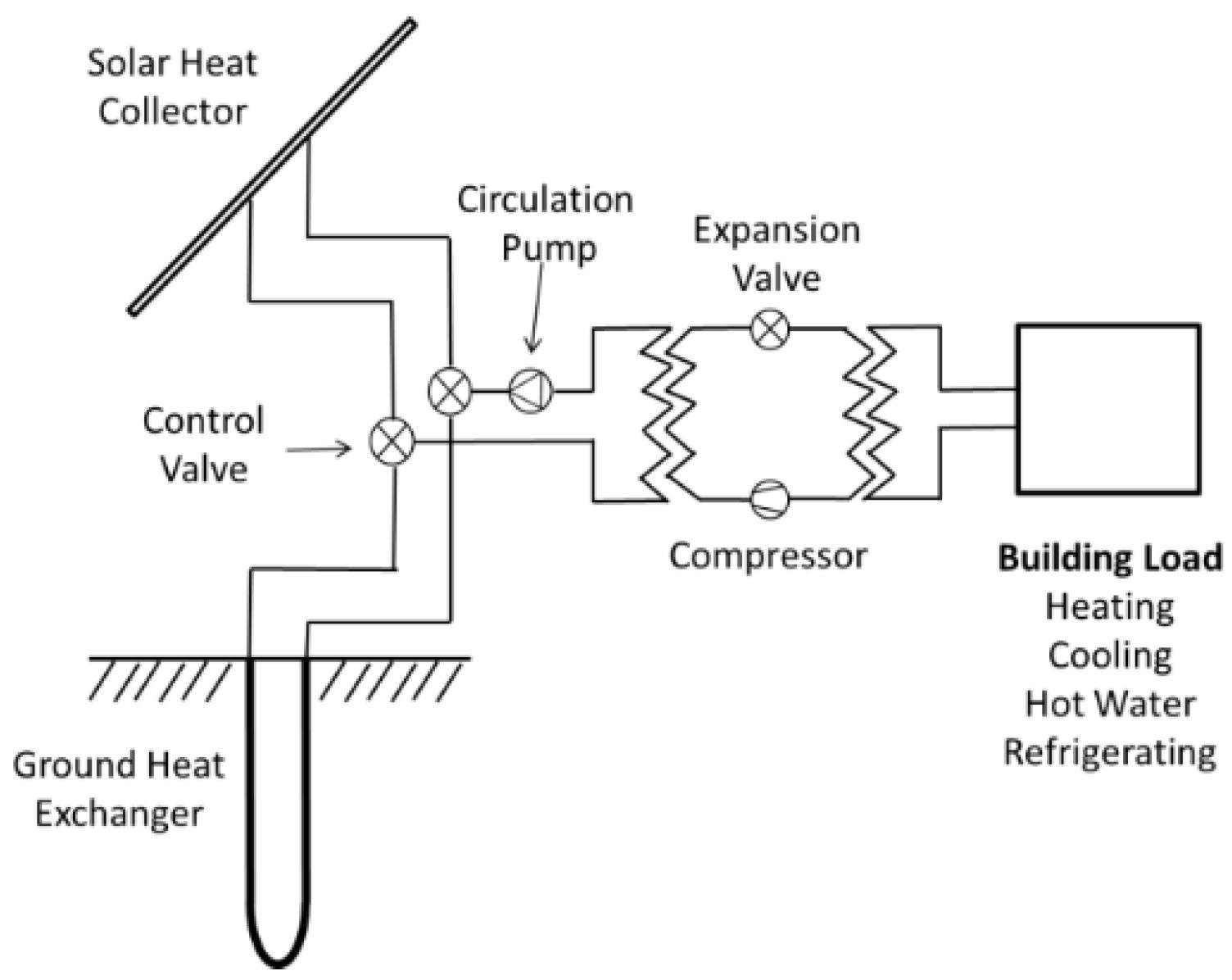
PVT technology combines photovoltaic electricity generation with low-temperature thermal collection in a single roof-mounted system. In ground source heat pump applications, PVT collectors can support geothermal systems by contributing renewable thermal energy to the brine loop and helping maintain seasonal ground balance.
Suitable for:
- Ground source heat pumps
- Borehole regeneration
- Brine loop systems
- Geothermal optimization
- Renewable heating projects
- Hybrid low-temperature energy systems
18–30%
Reduction in required borehole length
TRNSYS 20-year simulations, Nordic climates
33%
Less ground temperature drop over 50 years vs GSHP alone
Energy & Buildings 2024, ScienceDirect
+2.6%
Seasonal performance factor (SPF4) improvement
Applied Energy, 2024
Dual
Mode: winter heat source + summer ground recharge from one roof array
Why ground source systems need solar support
The ground thermal imbalance problem — and how PVT fixes it
In heating-dominated climates across Northern and Central Europe, a ground source heat pump extracts more thermal energy from the soil each winter than can naturally recover during summer. Over years, the ground temperature around the borehole field gradually falls — a process called soil thermal imbalance.
The consequences are measurable. As ground temperature drops, the heat pump’s evaporator operates at a lower source temperature, the compressor works harder, and the seasonal performance factor (SPF) declines. A system designed for SPF 4.0 may deliver 3.2 after a decade — without any fault in the equipment itself.
PVT panels address this at the root. In summer, when solar gain is highest and heating demand is minimal, the panels circulate warm brine back into the ground loop — injecting thermal energy into the soil and recharging the borehole to its design temperature. This solar regeneration restores the thermal balance that natural seasonal recovery alone cannot achieve in cold, heating-dominant regions.
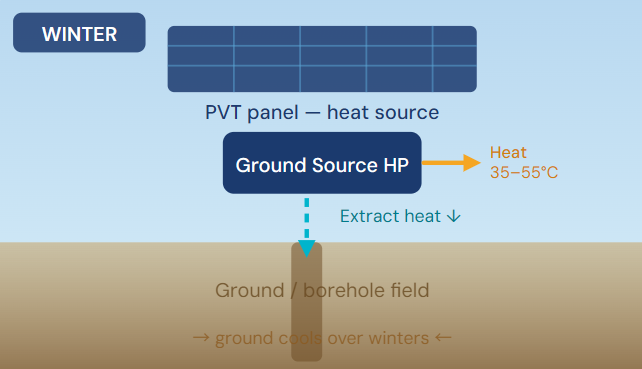
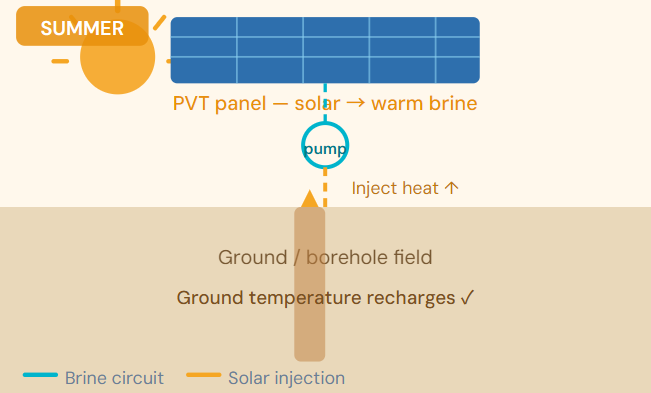
Winter: PVT panels supplement ground heat extraction, raising brine temperature at the evaporator. Summer: solar-heated brine is directed into the borehole field, recharging ground temperature for the next heating season.
System Operation
Two operating modes from one set of roof panels
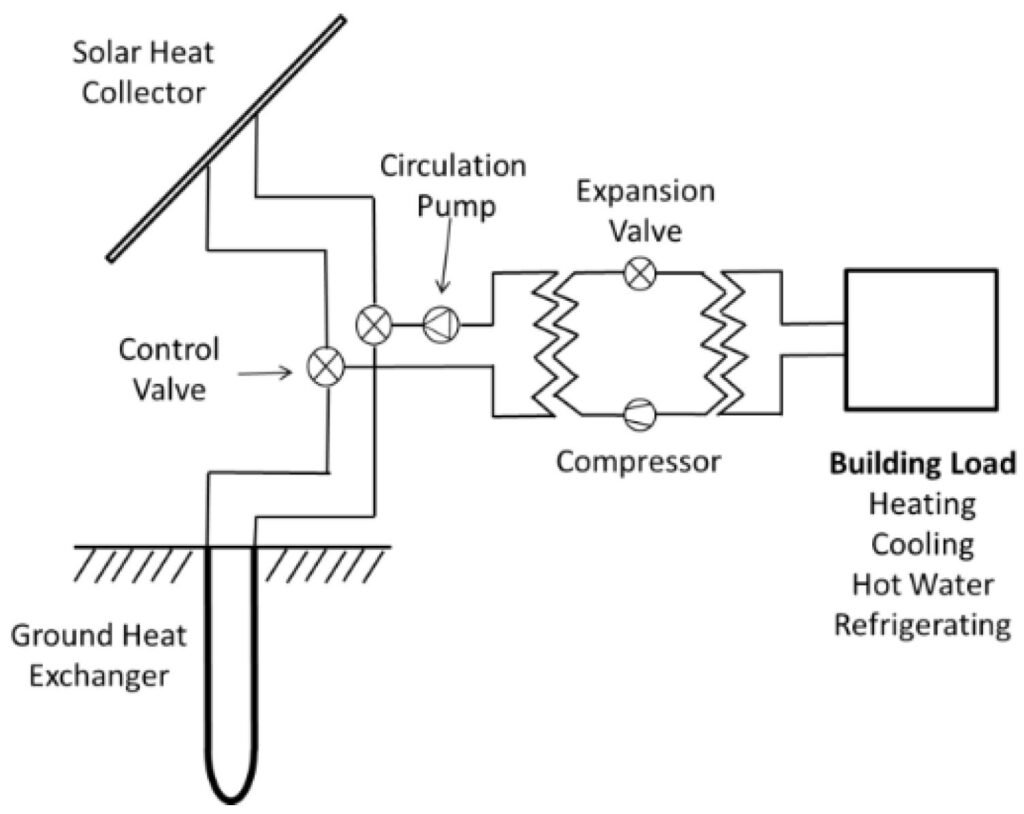
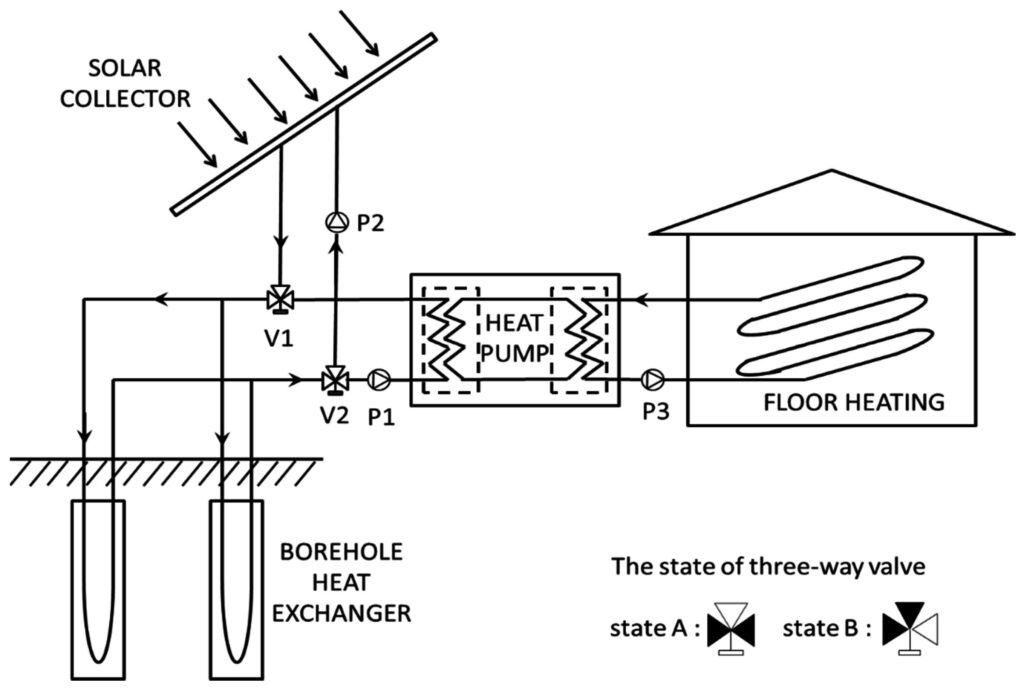
A motorised or three-way valve in the brine circuit switches between winter and summer operation — automatically or on a timer schedule set during commissioning.
❄ Winter mode — heat source
PVT panels supplement ground extraction
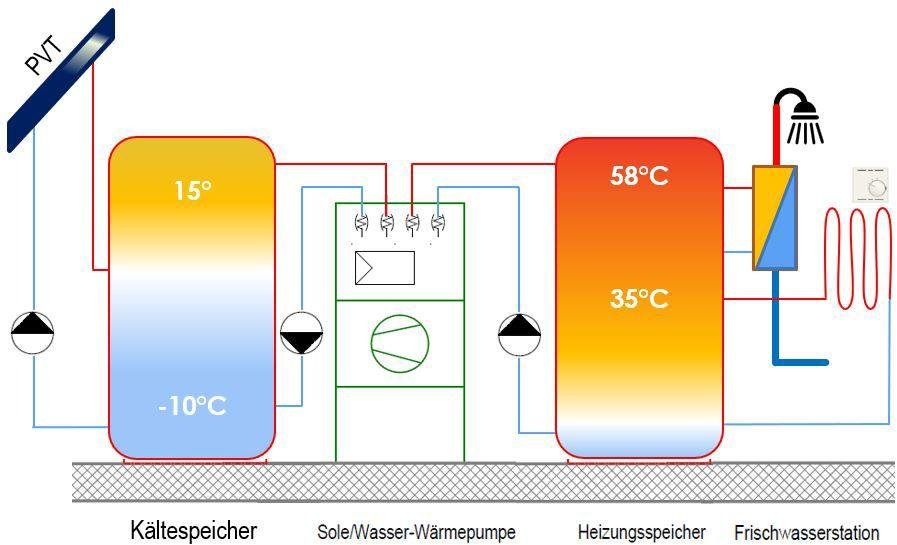
The panels deliver additional brine thermal energy to the heat pump’s evaporator alongside the ground loop. Even at low ambient temperatures, the absorber contributes 2–6 °C above ground temperature, reducing ground extraction load and limiting temperature draw-down around the boreholes. The heat pump sees a higher combined source temperature — improving COP during peak demand.
☀ Summer mode — ground regeneration
Solar heat recharges the borehole field
When space heating demand is minimal, warm brine from the PVT panels is directed into the borehole field via the ground loop. Solar energy is stored in the soil mass around the boreholes, raising ground temperature back toward its natural level. This recharge offsets winter draw-down and stabilises long-term system performance year on year.
1
PVT panels connect in parallel with the existing ground loop
The brine absorber circuit on the panel rear face joins the primary brine loop via a branch connection. A motorised or three-way valve directs flow either to the heat pump evaporator (winter) or into the borehole manifold (summer). Standard brine fittings are used — no modification to the heat pump refrigerant circuit required.
In winter: brine temperature at the evaporator rises
Combined brine from the ground loop and PVT absorbers enters the evaporator at a marginally higher temperature than ground-only supply. COP improvement per degree Kelvin of source temperature rise is typically 2–3%. Over a heating season this compounds into a measurable SPF gain without changing any heat pump settings.
In summer: solar heat is stored in the ground mass
At absorber temperatures of +15 °C to +35 °C — well above ground temperature — warm brine circulates through the borehole heat exchangers, transferring heat to the surrounding soil. This seasonal thermal storage is most effective in compact borehole fields with low groundwater movement, where natural recovery is slowest.
PV electricity reduces the heat pump’s running cost
The PV cell layer generates electricity throughout the year. Connected via a standard grid-tied or battery inverter, PV output offsets the heat pump’s electrical consumption — reducing net operating cost regardless of which brine circuit mode is active.
What the research shows
Published evidence on PVT + GSHP performance
The following figures are drawn from peer-reviewed engineering research on PVT-assisted ground source systems in Northern and Central European climates. Numbers vary by site conditions and are cited here for design context, not as guaranteed outcomes.
Key research findings
18–30%
Reduction in required borehole length achievable while maintaining equivalent seasonal performance factor. Studies using TRNSYS 20-year dynamic simulation in Swedish multi-family buildings also show borehole spacing can be reduced by up to 50% when PVT regeneration is included in the design — significantly cutting the land area required for the borehole field.
Sommerfeldt & Madani — TRNSYS 20-year simulation; peer-reviewed journal.
33%
Less ground temperature reduction over 50 years in large, compact borehole fields with PVT added, compared to GSHP without solar regeneration. Smaller borehole fields showed 13% improvement, as natural seasonal recovery plays a larger role at smaller scale.
ScienceDirect — Energy & Buildings 2024; Nordic case study, Baltic and cold continental climates
+2.6%
Improvement in SPF4 (seasonal performance factor including all system auxiliaries) when PVT is placed on the evaporator side of the circuit. Grid electricity import reduced by 3.6% in the same configuration.
Applied Energy, 2024 — techno-economic analysis of GSHP + PVT in heating-dominated regions
up to 95%
Reduction in required borehole field land area in some configurations while maintaining equivalent energy performance — most relevant for dense urban sites with constrained ground access. This is an upper-bound scenario; typical residential cases see 30–50% area reduction
Energy & Buildings 2024 — scenario analysis across Nordic building types
Performance gains vary by climate, building load profile, borehole field size, and groundwater conditions. Sites with significant groundwater movement achieve natural regeneration without PVT; solar recharge is most valuable in low-groundwater, heating-dominated locations.
Why Combine PVT with Ground Source Heat Pumps?
Ground source heat pumps operate most efficiently when the source temperature remains stable throughout the year. PVT collectors can contribute renewable thermal input to support the geothermal loop while simultaneously generating electricity from the same roof area.
This makes PVT increasingly relevant in modern geothermal heating projects.
Borehole Regeneration
Renewable thermal input can help support seasonal geothermal recovery and stabilize ground temperatures.
Reduced Drilling Demand
Additional thermal support may reduce pressure on borehole sizing in selected projects.
Dual Energy Generation
Generate electricity and thermal energy simultaneously from one collector area.
Improved Seasonal Efficiency
More stable source temperatures can support long-term heat pump performance.
Roof Space Optimization
Combine photovoltaic and thermal collection within the same installation footprint.
Renewable Heating Integration
Suitable for hybrid renewable heating and low-temperature energy systems.
How PVT Supports Ground Source Heat Pumps
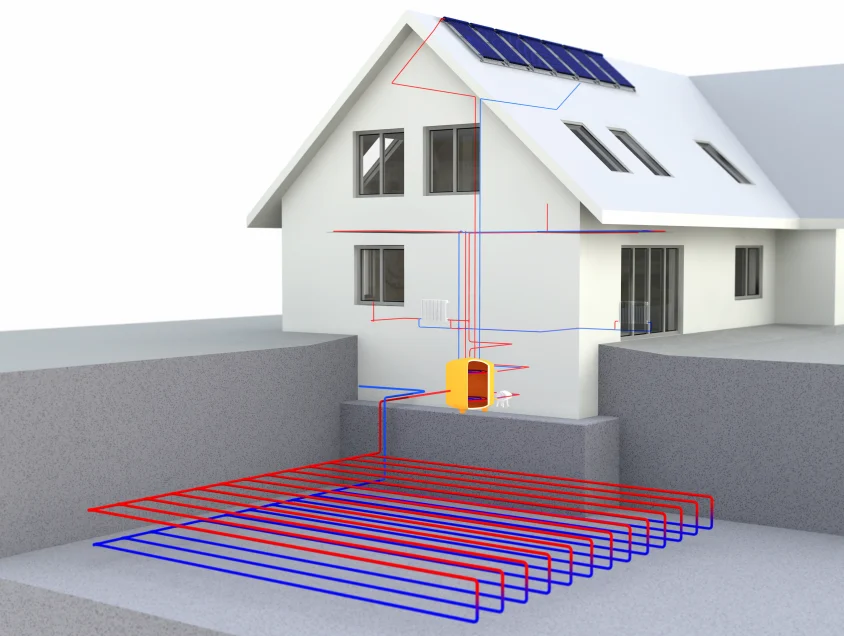
In a PVT-supported geothermal system, a heat transfer fluid circulates through the thermal side of the collector and transfers renewable heat into the brine loop or geothermal storage system.
During warmer periods, renewable thermal energy collected from solar radiation, roof temperature and ambient air conditions can contribute to seasonal ground recovery.
During colder periods, the stabilized geothermal source can help improve heat pump operating conditions and support overall system efficiency.
At the same time, the photovoltaic surface continues generating electricity that may contribute to heat pump power consumption and overall building self-consumption.
This integrated approach allows simultaneous electrical and thermal energy utilization within the same roof area.
Typical Applications
Residential Ground Source Heating
PVT-supported geothermal systems are increasingly considered in residential renewable heating projects where roof energy utilization and seasonal efficiency are important.
Typical applications include:
- Single-family homes
- Low-energy buildings
- Rural geothermal projects
- Hybrid renewable heating systems
Multi-Residential & Commercial Projects
Large-scale geothermal systems may use PVT technology to support renewable heating performance and improve long-term geothermal stability.
Typical applications include:
- Apartment buildings
- Community heating systems
- Educational facilities
- Commercial renewable heating
- Municipal projects
Retrofit & Geothermal Upgrades
PVT collectors can also be considered in retrofit projects where existing geothermal systems require additional renewable thermal support.
Typical retrofit concepts include:
- Existing GSHP optimization
- Borehole temperature recovery
- Renewable heating upgrades
- Seasonal efficiency improvements
Technology comparison
PVT Ground Source System Concepts
PVT-Optimized GSHP
Recommended for:
- Borehole regeneration
- Residential geothermal systems
- Seasonal thermal balancing
- Brine loop support
Hybrid Renewable Heating
Recommended for:
- PVT + geothermal + buffer systems
- Low-temperature heating
- Integrated renewable HVAC
- High self-consumption projects
Geothermal Retrofit Projects
Recommended for:
- Existing borehole systems
- Performance optimization
- Renewable upgrades
- Existing GSHP support
Technology comparison
PVT-optimised GSHP vs standard configurations
For system designers weighing long-term performance against upfront cost, PVT integration shifts the economics by reducing initial drilling cost and avoiding SPF decline that would otherwise require remedial works.
SPF values are illustrative ranges for a well-insulated Northern European residential building with underfloor heating. Actual performance depends on climate zone, building load profile, and system design.
| Criterion | GSHP only | GSHP + PV only | GSHP + PVT |
|---|---|---|---|
| Initial borehole field size | Full design depth | Full design depth | 18–30% shorter |
| Long-term ground temperature | Declining (heating-dominant sites) | Declining | Stabilised via solar recharge |
| SPF over 10–20 years | Declining | Declining | Maintained or improving |
| Summer borehole regeneration | No | No | Yes — active solar injection |
| On-site electricity generation | No | Yes | Yes (same panel) |
| Roof area required | None | PV panels only | PVT panels (PV + thermal) |
| Retrofit to existing GSHP | N/A | Simple | Via brine loop — no drilling |
Why ground source systems need solar support
Borehole Regeneration with PVT
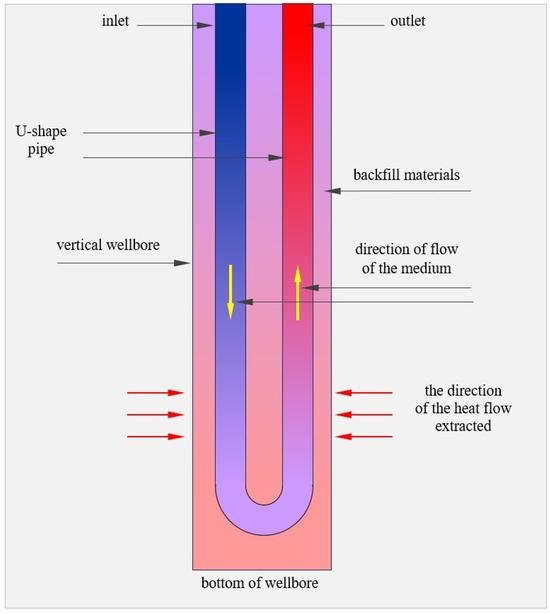
Borehole regeneration refers to restoring seasonal thermal balance within geothermal systems using renewable thermal input.
In some ground source installations, annual thermal extraction can exceed the natural regeneration capacity of the surrounding ground. Over time, this may lead to reduced source temperatures and lower heat pump efficiency.
PVT collectors can contribute renewable low-temperature heat to the brine loop during periods of available solar energy. This concept is increasingly explored in geothermal systems where:
- Borehole temperatures decline over time
- Additional drilling is limited
- Roof space is available
- Seasonal geothermal balancing is required
PVT-supported borehole regeneration is increasingly discussed in Nordic and European renewable heating projects where integrated geothermal optimization is important.
Product
PVT brine collector — specification for GSHP integration
The panel used in GSHP applications is our insulated brine PVT collector: a standard crystalline silicon PV module with a stainless-steel serpentine absorber bonded to the rear face, backed by a mineral wool insulation layer. The insulation improves net thermal delivery to the brine circuit by reducing rear-face heat loss.
For GSHP integration, the panel connects to the primary brine loop alongside the borehole heat exchanger manifold. In summer regeneration mode, absorber temperatures of +15 °C to +40 °C are typical on south-facing roofs — well above ground temperatures of +5 °C to +12 °C — creating a useful driving temperature difference for ground injection.
Full technical datasheets including thermal output tables at 200 / 400 / 800 W/m² irradiance and brine circuit flow specifications are available for system design purposes.
| Parameter | Value |
|---|---|
| Absorber type | Stainless-steel serpentine, rear-bonded |
| Heat transfer fluid | Propylene-glycol / water (30–40%) |
| Operating temp range | −15 °C to +70 °C |
| Rear insulation | Mineral wool, rear face |
| PV cell type | Crystalline silicon (standard module) |
| Summer absorber temp | +15 °C to +40 °C (south-facing) |
| Brine connection | 22 mm or 28 mm compression |
| Frame | Anodised aluminium |
| Mounting | Standard roof hooks or ballast frame |
Design guidance
How to size PVT panels for a GSHP project
PVT panel sizing for GSHP integration has two components: winter source contribution (how much brine energy the panels add to the evaporator in the heating season) and summer regeneration capacity (how much thermal energy the panels inject into the ground per season).
For regeneration-focused design, a rule of thumb is 0.5–1.0 m² of PVT panel per metre of borehole depth to offset annual extraction. For a 100 m borehole field, 50–100 m² of PVT (15–30 standard panels) provides meaningful regeneration contribution in Northern/Central European climates.
For new-build projects where the goal is to reduce initial borehole length, we calculate the panel area needed to allow a 20–25% reduction in drilling depth while maintaining long-term ground temperature balance. This requires site-specific climate data and building heat demand inputs.
| Borehole field | PVT area for regeneration |
|---|---|
| 1 × 50 m borehole | 25–50 m² (8–15 panels) |
| 2 × 50 m boreholes | 50–100 m² (15–30 panels) |
| 1 × 100 m borehole | 50–100 m² (15–30 panels) |
| 4 × 75 m boreholes | 150–300 m² (45–90 panels) |
Indicative values for Northern/Central European climates with heating-dominated load profiles. Actual sizing depends on ground thermal conductivity, annual heat extraction volume, and roof orientation.
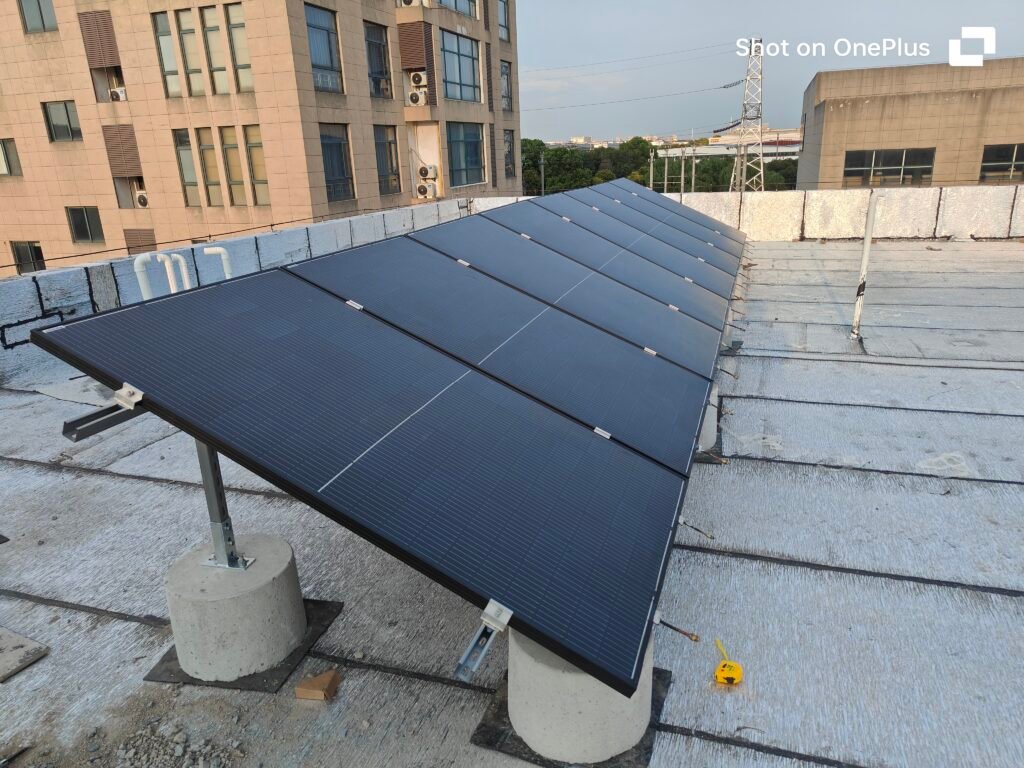
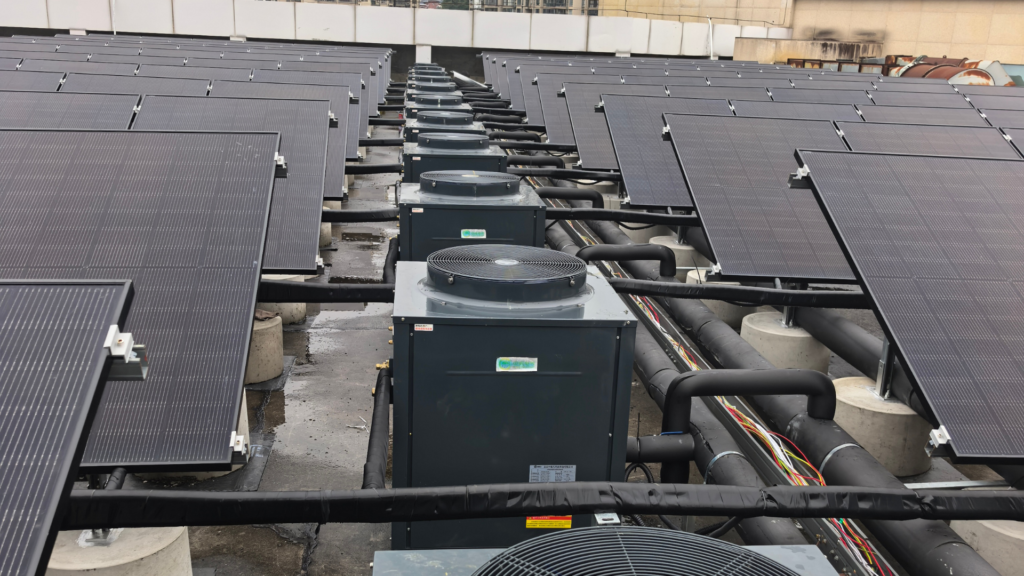
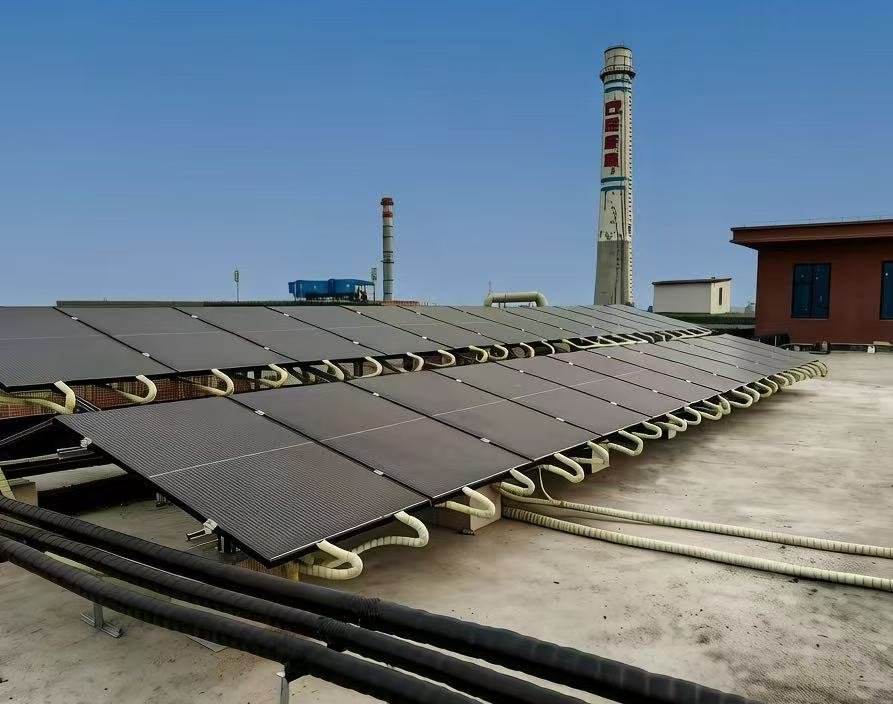
Commercial buildings
Efficient energy for a productive office. Efficient energy for productive manufacturing
Frequently Asked Questions
A PVT ground source heat pump system combines photovoltaic electricity generation and thermal collection with geothermal heating applications.
PVT collectors can contribute renewable thermal energy to support the brine loop and seasonal geothermal balance..
Borehole regeneration refers to restoring geothermal ground temperatures using renewable thermal input.
Stable source temperatures may support improved heat pump operating conditions over time.
In some projects, additional renewable thermal support may reduce pressure on borehole sizing strategies.
Yes. PVT is increasingly explored in residential renewable heating applications involving GSHP systems.
DualSun markets their SPRING4 panel specifically for GSHP regeneration — their Heinöhem community project is a well-documented field reference. Their panel uses an aluminium flat-plate heat exchanger as the thermal absorber. Our panels use a stainless-steel serpentine absorber with rear insulation, delivering brine at comparable operating temperatures across the same seasonal cycle. The borehole circuit connection approach is equivalent. We provide thermal output data sheets for direct comparison, and our panels connect to any brine heat pump without requiring a proprietary system or heat pump brand.
Yes. PVT systems are designed to produce photovoltaic electricity and usable thermal energy within the same collector structure.
Typical applications include residential heating, multi-family buildings, retrofit geothermal projects and commercial renewable heating systems.
PVT panels connect to the borehole brine circuit in series (between borehole outlet and heat pump inlet) or via a parallel injection loop directly into the borehole manifold. No modification to the heat pump refrigerant circuit is required — only the brine source side is affected. A circulation pump, expansion vessel, and differential temperature controller complete the PVT circuit. This is a standard brine-side addition accessible to any HVAC contractor familiar with GSHP borehole circuits.
Published research indicates 20–40% reduction in borehole field length for heating-dominated Central and Northern European climates. The EuroSun 2020 study modelled a reduction from 12 boreholes to 7 (3,600 m to 1,500 m total length) for a reference project in Swedish conditions while maintaining system performance. Actual reduction depends on the thermal imbalance of the specific project: buildings with high heating-to-cooling ratios benefit most. A building with minimal or zero cooling load has the highest thermal imbalance and therefore benefits most from PVT regeneration.
Thermal depletion occurs when a GSHP extracts more heat from the ground annually than the earth naturally recharges. In heating-dominated climates, this net deficit gradually cools the ground — lowering average brine temperature and reducing the heat pump’s COP over time. Studies show ground temperature can drop by 3–5°C over 20–30 years in poorly balanced systems, increasing running costs by 15–25%. It typically becomes measurable after 10–15 years and practically significant in systems approaching their 20-year mark without corrective action.
In cases of moderate undersizing — where the borehole delivers acceptable winter performance initially but declines over years — PVT regeneration can stabilise and gradually restore brine temperatures without additional drilling. For severely undersized fields where winter brine temperature is already at the heat pump’s minimum operating limit, PVT supplementation can extend the effective capacity but may not fully compensate for a major shortfall. Site-specific assessment is recommended before specifying PVT as the sole remediation measure.
DualSun markets their SPRING4 panel specifically for GSHP regeneration — their Heinöhem community project is a well-documented field reference. Their panel uses an aluminium flat-plate heat exchanger as the thermal absorber. Our panels use a stainless-steel serpentine absorber with rear insulation, delivering brine at comparable operating temperatures across the same seasonal cycle. The borehole circuit connection approach is equivalent. We provide thermal output data sheets for direct comparison, and our panels connect to any brine heat pump without requiring a proprietary system or heat pump brand.
Designing a ground source project with PVT regeneration?
Send us your borehole field specification, heat pump model, and building heat load. We supply technical data sheets, brine circuit connection diagrams, and sizing guidance.