
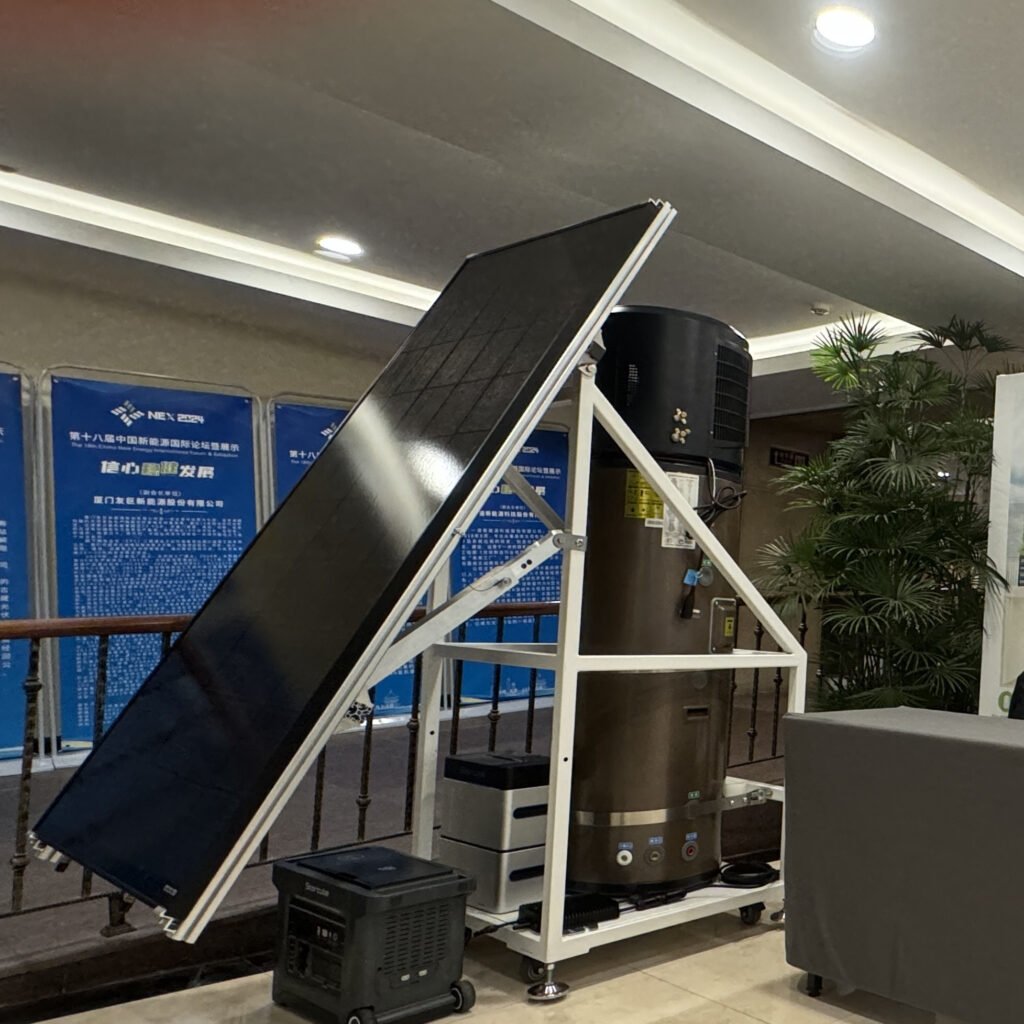
System type · Direct expansion PVT heat pump
In a direct expansion PVT system, refrigerant circulates through the panel absorber itself — no brine loop, no intermediate heat exchanger, no outdoor fan unit. The blown-aluminium absorber on the panel rear face acts as the evaporator of a standard vapour-compression heat pump, delivering space heating and domestic hot water at COP 3.5–5.4 from a compact, roof-integrated installation.
Direct expansion PVT technology combines photovoltaic electricity generation with refrigerant-based thermal collection in a single roof-mounted collector. The system allows simultaneous electrical and thermal energy utilization while supporting compact renewable heating and cooling concepts.
Suitable for:
- Solar-assisted heat pumps
- Refrigerant-based HVAC systems
- Compact renewable heating systems
- Integrated thermal collection
- Hybrid renewable energy projects
- Low-temperature heating applications
The panel is the evaporator — how direct expansion removes the middleman
Direct expansion PVT combines photovoltaic electricity generation and refrigerant-based thermal collection within the same collector structure.
Unlike liquid-based thermal collection systems that use water or brine as the heat transfer medium, direct expansion PVT uses refrigerant circulation integrated behind the photovoltaic module structure.
In DX PVT systems, refrigerant absorbs thermal energy directly from the collector surface before transferring that energy into the heat pump cycle.
At the same time, the photovoltaic surface generates electricity that can contribute to overall system self-consumption.
This integrated approach allows compact renewable heating concepts where electrical generation and thermal collection operate simultaneously from the same roof area.
Typical applications include:
- Solar-assisted heat pumps
- Refrigerant-based renewable HVAC systems
- Compact integrated heating systems
- Hybrid renewable thermal concepts
- Residential renewable heating projects
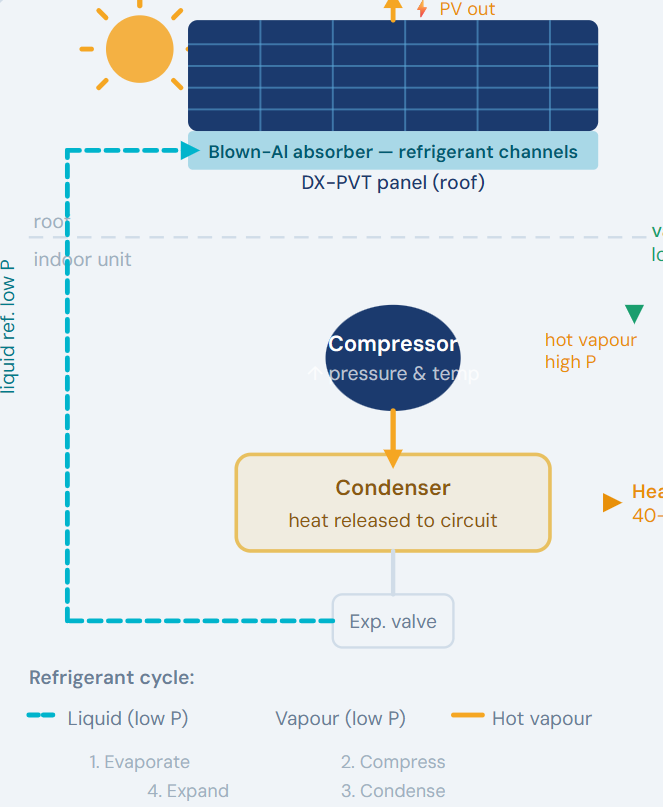
DX-PVT refrigerant cycle: liquid refrigerant enters the blown-aluminium panel absorber (evaporator), evaporates absorbing solar + ambient heat, passes through the compressor, releases heat at the condenser (40–60°C), then expands back to low pressure. PV electricity generated simultaneously from the panel front face.
Why Use PVT with Heat Pumps?
Direct expansion PVT systems are increasingly explored in applications where compact integration, refrigerant-based thermal transfer and renewable energy utilization are priorities.
By integrating thermal collection directly into the refrigerant loop, DX PVT systems simplify thermal transfer concepts while maintaining photovoltaic electricity generation.
Simultaneous Electricity & Thermal Collection
Generate photovoltaic electricity while collecting usable thermal energy from the same surface.
Refrigerant-Based Thermal Transfer
Thermal energy is transferred directly through the refrigerant loop.
Compact System Integration
Suitable for integrated renewable HVAC concepts and space-efficient installations.
Roof Space Optimization
Combine photovoltaic and thermal functions within one collector area.
Solar-Assisted Heating Concepts
Can support renewable heating and cooling applications.
Hybrid Renewable Applications
Suitable for selected hybrid renewable HVAC projects.
Five stages of a DX-PVT heat pump cycle
In a direct expansion PVT system, refrigerant circulates through the thermal side of the collector positioned behind the photovoltaic surface.
As solar radiation and ambient conditions heat the collector structure, thermal energy is absorbed directly into the refrigerant circuit.
This renewable thermal input can then contribute to the heat pump cycle depending on overall system configuration.
At the same time, the photovoltaic surface continues generating electrical power for building consumption or heat pump operation.
Because the thermal transfer occurs directly within the refrigerant circuit, DX PVT systems are often explored for compact renewable HVAC concepts where simplified thermal integration is important.
Refrigerant enters the panel absorber as low-pressure liquid
After passing through the expansion valve, refrigerant enters the blown-aluminium absorber channels at low pressure and low temperature — typically −5 °C to +5 °C. The absorber is bonded to the rear face of the PV panel, which is warmer than the refrigerant due to solar irradiance absorption and ambient heat contact.
Refrigerant evaporates in the absorber — absorbing solar and ambient heat
As refrigerant flows through the absorber channels, it absorbs heat from three simultaneous sources: residual heat from PV cell operation (which would otherwise reduce PV efficiency), direct solar irradiance transmitted through or absorbed at the backsheet, and ambient air convection on the rear and edges of the panel. The refrigerant evaporates fully before exiting the panel array as low-pressure vapour.
Compressor raises pressure and temperature
Low-pressure vapour from the panel suction line enters the compressor. Compression raises the refrigerant temperature to 60–90 °C discharge temperature. The compressor’s electrical input is the system’s only energy consumption — fed from the grid, a battery, or partially offset by PV output from the same panels.
Condenser delivers heat to the building circuit
Hot high-pressure refrigerant passes through the condenser — a refrigerant-to-water heat exchanger that transfers heat to the domestic hot water cylinder or space heating circuit at 40–60 °C. The refrigerant exits the condenser as warm high-pressure liquid. A three-way valve can prioritise DHW or space heating depending on system demand.
Expansion valve returns refrigerant to low pressure — cycle repeats
The thermostatic or electronic expansion valve drops refrigerant pressure and temperature, returning it to the panel absorber inlet condition. The cycle operates continuously while the compressor runs. The PV cells generate electricity throughout — independently of which stage of the refrigerant cycle is active.
DX-PVT vs brine PVT — which to specify
Both systems use a PVT panel as the heat source for a heat pump. The choice between direct expansion and brine depends on installation constraints, heat pump type, and refrigerant circuit length.
DX-PVT — best when
- Panel array is within 10–15 m of the compressor unit (refrigerant line length constraint)
- Maximum COP efficiency per m² of panel is the priority
- No outdoor fan unit or evaporator noise is a requirement
- New build or roof replacement where the full refrigerant system is designed from scratch
- Domestic hot water or small space heating load for 1–4 person household
- Compact installation where brine pump room and heat exchanger space is not available
Brine PVT — best when
- Panels are far from the compressor unit (brine lines are cheaper and simpler over long distances than refrigerant lines)
- Retrofit to an existing brine heat pump with a standard source circuit
- Large panel arrays (10+ panels) where refrigerant distribution becomes complex
- GSHP borehole regeneration application requiring summer injection mode
- Installer prefers glycol brine system they are familiar with from solar thermal
- Multiple connection points (DHW + space heating + pool) requiring flexible hydraulics
Installation note on refrigerant line length
In a DX-PVT system, refrigerant lines run from the indoor compressor/condenser unit to the roof-mounted panel array. Maximum recommended line length varies by refrigerant and compressor specification — typically 10–20 m for residential systems. For longer runs, brine PVT is the more practical choice. We advise on the appropriate system type based on the specific building layout and heat pump specification.
Typical DX-PVT installations
New-build DHW + space heating
4–8 panels on a south-facing roof supply a DX heat pump for a 100–180 m² well-insulated home. The system covers domestic hot water year-round and contributes to space heating via underfloor or low-temperature radiators in winter. PV output partially powers the compressor.
Rooftop DHW for apartments
Flat rooftop installations using ballast-framed panels at 10–15° tilt supply a DX heat pump for building DHW. The compact compressor unit sits in a plant room. No outdoor fan unit noise — relevant for urban residential buildings where planning restrictions apply to ASHP outdoor units.
Replacing gas boiler in constrained spaces
Properties without outdoor space for a conventional ASHP unit — terraced houses, courtyards, noise-sensitive locations — benefit from DX-PVT’s absence of an outdoor fan unit. The compressor fits in an indoor utility space; only insulated refrigerant lines penetrate the roof.
High self-sufficiency combined system
Paired with a home battery and PV inverter, the DX-PVT system’s own panels partially cover compressor electricity demand during daylight hours. Summer daytime operation can approach near-self-sufficient heat pump operation for DHW — the panel simultaneously evaporates refrigerant and generates the electricity driving the compressor.
18–30%
Reduction in required borehole length achievable while maintaining equivalent seasonal performance factor. Studies using TRNSYS 20-year dynamic simulation in Swedish multi-family buildings also show borehole spacing can be reduced by up to 50% when PVT regeneration is included in the design — significantly cutting the land area required for the borehole field.
Sommerfeldt & Madani — TRNSYS 20-year simulation; peer-reviewed journal.
Published DX-PVT performance measurements
The following figures are from peer-reviewed experimental studies and field installations. Performance varies by climate, refrigerant, panel design, and operating condition — values cited for design context, not as guaranteed outcomes.
2.94–3.82
Daily average COP measured over 8 months in a year-round real engineering installation in Dalian, China — a heating-dominated cold climate with winter temperatures reaching −15 °C. System provided domestic hot water, space heating, and cooling.
ScienceDirect — Multigenerational performance of DX-PVT-HP, year-long experimental data, 2025
4.76
Peak COP at 400 W/m² irradiance and 10 °C ambient, with PV electrical efficiency of 13.5%, in a comparative DX-SAHP vs DX-PVT-SAHP analysis. The addition of PV cells to the DX-SAHP evaporator improved both thermal and electrical performance simultaneously.
MDPI Processes — Comparative analysis DX-SAHP with and without PVT, 2026
5.4
Average COP reported for a roll-bond DX-PVT heat pump system using sheet-and-tube collectors, under 200–800 W/m² irradiance at 15 °C ambient. The roll-bond panel design distributes refrigerant across the full panel rear face, maximising evaporator area.
ScienceDirect — DX-PVT HP performance review, citing Ji et al. experimental system
+81%
Average seasonal performance factor (SPF) increase of PVT-DX-SAHP versus DX-SAHP without PV cells, along with a significant reduction in total equivalent warming impact (TEWI). The addition of PV cells improves both energy efficiency and environmental footprint simultaneously.
MDPI — Comparative DX-SAHP analysis, 2026; Brazilian climate conditions
4.0+
COP exceeding 4.0 simulated for a vapour-injected roll-bond DX-PVT system at −10 °C ambient and 500 W/m² irradiance — demonstrating that DX-PVT can maintain useful efficiency at sub-zero temperatures where conventional ASHP typically delivers COP 2.0–2.5.
ScienceDirect — Vapour-injected DX-PVT HP performance optimisation, 2023
Research conditions vary — climate, refrigerant type (R410A, R290, R32), panel absorber design, and system configuration all affect outcomes. Site-specific performance modelling is provided on request for project design purposes.
DX-PVT panel — blown-aluminium absorber specification
The Solis PVT direct expansion panel uses a blown-aluminium flat-plate absorber bonded to the rear face of a standard crystalline PV module. The blown-aluminium construction creates a network of flat refrigerant channels distributed across the full panel rear area — maximising heat transfer contact with the PV backsheet and providing a low refrigerant pressure drop across the panel.
Unlike the stainless-steel serpentine absorber used in our brine PVT panels, the blown-aluminium design has no welded joints in the refrigerant path — channels are formed by the inflation of the aluminium sheet itself. This results in a lightweight, uniform absorber well-suited to refrigerant distribution across a panel array.
The refrigerant-compatible absorber works with R410A, R32, and R290 (propane) depending on the compressor unit specification. Working pressure and burst test ratings are supplied per the relevant refrigerant operating pressure requirements.
| Parameter | Value |
|---|---|
| Absorber type | Blown aluminium flat-plate, rear face |
| Refrigerant | R410A / R32 / R290 (project specific) |
| Operating pressure | Per refrigerant specification (test report supplied) |
| Operating temp range | −20 °C to +80 °C (refrigerant circuit) |
| PV cell type | Crystalline silicon (mono or poly) |
| Absorber construction | Blown aluminium — no welded joints in refrigerant path |
| Refrigerant connection | Copper flare fittings (size per refrigerant spec) |
| Max refrigerant line length | 10–20 m (system design specific) |
| Frame | Anodised aluminium |
| Mounting | Standard roof hooks or ballast frame |
Sizing a DX-PVT system
DX-PVT system sizing is primarily governed by the heat pump compressor’s nominal capacity and refrigerant charge requirements. The panel array area determines the evaporator surface — larger array means more refrigerant distribution pipe and a larger refrigerant charge, but also a higher evaporation temperature at a given ambient condition.
A general starting point is 2–3 m² of DX-PVT panel per kW of compressor rated heating output. For a 5 kW DHW heat pump, 10–15 m² of panel (3–4 standard panels) is a typical starting array. For combined space heating and DHW on a 6–8 kW system, 14–20 m² (4–6 panels) is common in Northern European climates.
Refrigerant charge, pipe sizing, panel connection configuration (series, parallel, or series-parallel), and expansion valve selection require system-specific design. We provide refrigerant circuit design support and panel sizing calculations for each project.
| Heat pump output | DX-PVT panel area |
|---|---|
| 3 kW (DHW only) | 6–10 m² (2–3 panels) |
| 5 kW (DHW + small space) | 10–15 m² (3–4 panels) |
| 6 kW (space + DHW) | 12–18 m² (4–5 panels) |
| 8 kW (space + DHW) | 16–24 m² (5–7 panels) |
| 10 kW (larger home) | 20–30 m² (6–9 panels) |
Values are indicative for Northern/Central European climates, south-facing 30–45° pitch. Refrigerant line length, roof orientation, and local design temperature affect sizing. Detailed refrigerant circuit design provided per project.
DX-PVT vs brine PVT vs conventional air source heat pump
For system designers and installers comparing heat pump configurations, DX-PVT occupies a distinct position — higher COP than ASHP, simpler installation than brine PVT, but with specific refrigerant line length constraints.
| Criterion | ASHP (air source) | Brine PVT HP | DX-PVT HP |
|---|---|---|---|
| Outdoor unit / fan noise | Yes — outdoor fan unit | No outdoor fan unit | No outdoor fan unit |
| Electricity generated on-site | No | Yes — PV from panel | Yes — PV from panel |
| Number of heat transfer stages | 1 (air → refrigerant) | 2 (solar/air → brine → refrigerant) | 1 (solar/air → refrigerant direct) |
| Typical average COP (field) | 2.5–3.5 | 3.0–4.0 | 2.94–3.82 (field), up to 5.4 peak |
| Brine pump / glycol loop | Not applicable | Required | Not required |
| Panel-to-unit distance constraint | No constraint (air unit outdoor) | Flexible — brine lines up to 50+ m | 10–20 m refrigerant line limit |
| Defrost cycle required | Yes — in cold/humid conditions | Not required (brine circuit) | Minimal — absorber geometry reduces frosting |
| Ground works | None | None (brine PVT roof only) | None |
Frequently Asked Questions
Direct expansion PVT combines photovoltaic electricity generation and refrigerant-based thermal collection within the same collector structure.
Refrigerant circulates behind the photovoltaic surface and absorbs renewable thermal energy directly from the collector.
Yes. DX PVT systems are designed to simultaneously produce photovoltaic electricity and thermal energy.
DX PVT is commonly discussed in solar-assisted heat pump systems and integrated renewable HVAC concepts.
Yes. DX PVT may be explored in residential renewable heating and cooling applications.
Yes. DX PVT can be integrated into selected hybrid renewable HVAC concepts.
DX PVT combines photovoltaic and thermal functions within one collector area, helping maximize roof energy utilization.
Without solar input, the panel absorber functions as a passive air-to-refrigerant evaporator — effectively a large, flat outdoor coil exposed to ambient air. The blown-aluminium surface has good contact with ambient air and sky radiation. At ambient temperatures above −10 °C, the system continues to operate as a conventional air-source heat pump with the panel array as the evaporator, typically delivering COP 2.2–3.0 depending on ambient temperature. Performance at night or in winter is lower than peak solar conditions but comparable to a similarly-sized ASHP outdoor unit.
DX PVT uses refrigerant as the heat transfer medium, while liquid-based PVT systems typically use water or brine.
The most common refrigerants for DX-PVT systems are R410A (existing installations, phasing out under F-Gas regulation), R32 (current mainstream residential heat pump refrigerant), and R290 (propane — natural refrigerant, low GWP, increasingly specified for European new installations). R290 requires specific handling and installation procedures due to flammability classification. The blown-aluminium absorber is compatible with all three; the compressor unit and refrigerant charge specification must match the chosen refrigerant. We supply panels compatible with R32 and R290 systems as standard.
Frosting on the evaporator surface occurs when surface temperature falls below the dew point of ambient air — a common issue with conventional ASHP outdoor coils. DX-PVT panels have several characteristics that reduce frost risk: the large, flat absorber surface with low air velocity contact reduces the intensity of frost formation compared to a finned-tube coil; solar irradiance during daylight hours prevents frost formation when irradiance is above approximately 100 W/m²; and the panel’s thermal mass delays temperature drop during defrost events. In most Northern European climates, panels installed at 30–45° roof pitch shed ice effectively. Severe frosting in cold, high-humidity conditions may require a defrost cycle similar to standard ASHP practice.
Yes, with a reversible heat pump cycle. In cooling mode, the refrigerant cycle reverses — the condenser becomes the evaporator (absorbing heat from the building) and the panel absorber becomes the condenser (rejecting heat to the roof and sky). This is less common in Northern European climates where cooling demand is low, but is a practical option in Central and Southern Europe. The ScienceDirect year-round field study referenced in the evidence section tested all three modes: heating, DHW, and cooling — confirming practical trifunctional operation of a DX-PVT system in a real building.
Roll-bond and blown-aluminium refer to the same basic manufacturing concept — an aluminium sheet with internal channels formed by inflating the material under pressure rather than by welding or bonding separate tube elements. The term “roll-bond” is commonly used in research publications, particularly from China, while “blown aluminium” describes the same product in European market terminology. Both result in a flat, lightweight aluminium absorber with distributed refrigerant channels and no welded joints in the refrigerant path. Our DX-PVT panel uses this blown/roll-bond aluminium construction.
For most new residential installations where the panel-to-compressor distance is under 15 m, DX-PVT is often the more efficient choice — fewer system components, higher COP, and no brine loop maintenance. If the panel array needs to be far from the indoor unit, or if the system needs to serve multiple circuits (DHW + space heating + pool + possible future GSHP borehole regeneration), brine PVT provides more flexibility. We assess both options for each project and recommend based on the specific building layout, heat demand, and roof configuration. Send us the project details and we will advise on the most appropriate system.
Explore Direct Expansion PVT Solutions
Explore refrigerant-based solar PVT collectors designed for renewable HVAC systems, solar-assisted heating and integrated rooftop energy applications.
