
Solar hot water and electricity — from one panel, one roof area.
A PVT panel does what a solar thermal collector does — heats domestic hot water — while also generating electricity from the same surface. No separate PV array needed alongside your solar thermal. No heat pump required. The same stainless absorber that preheats your water also keeps the PV cells cooler, maintaining electrical output closer to rated values on hot summer days.
PVT technology combines photovoltaic electricity generation with thermal energy collection in a single roof-mounted collector. In residential applications, PVT systems can support domestic hot water production while simultaneously generating photovoltaic electricity from the same roof area.
Suitable for:
- Domestic hot water systems
- Residential renewable heating
- Solar water pre-heating
- Pool heating support
- Hybrid solar energy systems
- Low-temperature thermal applications

Why PVT makes more sense than solar thermal alone in 2025
Solar thermal collectors for domestic hot water have been installed across Europe for decades. They work well in summer but are often undersized for winter and take up roof area that could otherwise generate electricity. A separate PV array then competes for the same roof space.
A PVT panel resolves this directly. The rear face carries a stainless-steel serpentine absorber backed by mineral wool insulation — it heats brine exactly as a solar thermal collector would, at the same operating temperatures and with compatible storage tanks and controls. The front face is a standard crystalline PV module generating electricity simultaneously.
The thermal efficiency of an unglazed PVT panel at DHW temperatures (30–55 °C) is lower than a glazed solar thermal collector — typically 30–40% versus 45–60% for thermal alone. But when you account for both outputs, a 5 m² PVT array delivers roughly twice the useful energy of a 5 m² PV-only installation, while matching a solar thermal collector’s DHW contribution from the same roof area. For most homeowners, this combined performance on a limited roof is the decisive factor.
No heat pump needed for DHW use
For domestic hot water applications, PVT panels connect to a standard solar DHW storage tank via a brine circuit and heat exchanger — identical in principle to a conventional solar thermal installation. No heat pump or refrigerant circuit is required. Existing solar thermal tanks can often be reused without modification.
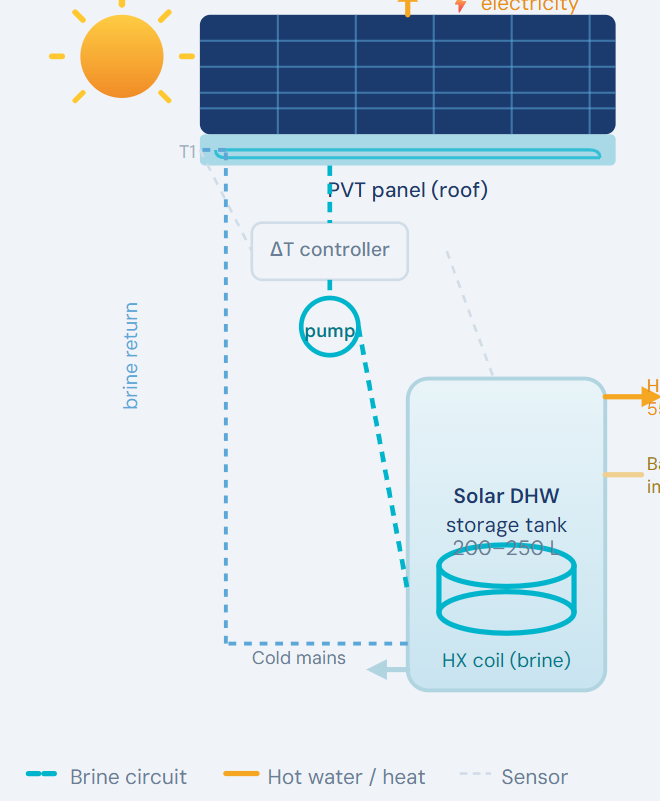
PVT DHW system: panel absorber heats brine → differential controller activates pump when ΔT ≥ 5–8 K → brine transfers heat to tank via coil → hot water drawn from tank top. PV electricity generated independently from panel front face.
Why Use PVT for Domestic Hot Water?
Traditional photovoltaic panels only generate electricity, while conventional solar thermal collectors only produce heat.
PVT systems combine both functions within the same collector area, allowing simultaneous photovoltaic generation and thermal energy recovery for residential hot water applications.
Electricity & Hot Water from One Roof
Generate photovoltaic electricity while supporting domestic hot water production.
Roof Space Optimization
Combine photovoltaic and thermal functions within the same installation footprint.
Renewable Hot Water Production
Use solar thermal energy to support residential water heating demand.
Improved Self-Consumption Potential
Increase on-site renewable energy utilization within residential buildings.
Suitable for Hybrid Energy Systems
Can integrate into selected renewable heating and hot water concepts.
Residential Renewable Upgrade
Suitable for new residential projects and selected retrofit applications.
How PVT panels heat domestic hot water — step by step
Solar irradiance heats the rear absorber and warms the brine
The stainless-steel serpentine absorber on the panel rear face absorbs residual heat from PV cell operation, direct solar irradiance penetrating the backsheet, and ambient thermal radiation. Propylene-glycol brine circulates through the absorber, gaining temperature. At 600 W/m² irradiance and 15 °C ambient, the absorber typically delivers brine at 35–50 °C depending on flow rate and brine inlet temperature.
Differential temperature controller activates the circulating pump
A differential temperature controller — a standard component in any solar thermal installation — continuously monitors two temperatures: the panel absorber sensor (T1) and the lower tank sensor (T2). When T1 exceeds T2 by 5–8 K, the controller switches on the brine circulating pump. When the differential falls below 2–3 K, the pump stops to prevent reverse heat loss. No manual operation is required.
Warm brine transfers heat to the tank via the lower coil
The circulating pump moves warm brine from the panel array down to the heat exchanger coil in the lower section of the solar storage tank. Heat passes from brine to tank water through the coil wall. The brine exits cooler and returns to the panel absorber inlet. The storage tank stratifies naturally — coolest water at the bottom near the coil, hottest at the top for drawing.
PV electricity is generated simultaneously — independently
While the brine circuit operates, the panel’s PV cells generate electricity from sunlight hitting the front face. The PV output connects via a standard string or micro-inverter to the building’s electrical system. The two circuits — brine thermal and PV electrical — operate independently and do not interfere with each other.
Backup heating covers night and winter shortfall
An immersion heater in the upper tank section, or a boiler connection via a second coil, maintains DHW temperature when solar gain is insufficient. The backup activates only when tank temperature falls below the set point — typically 55–60 °C for legionella safety. In summer, backup activation is rare. In winter at Northern European latitudes, backup covers 50–70% of the load on average.
How PVT compares to solar thermal and PV-only on the same roof area
For a 5 m² installation in Munich (Germany), annual simulation data from ScienceDirect shows the following comparison. PVT is not the most thermally efficient per m² — but it delivers the most total useful energy from a limited roof area.
Solar thermal only
(glazed flat plate)
Solar thermal only
(glazed flat plate)
PV only
(standard module)
Thermal output Electrical output Data source: ScienceDirect WISC-PVT simulation study, Munich (Germany), 5 m² / 400L tank.
Five reasons installers are switching from solar thermal to PVT for DHW
Standard photovoltaic panels generate electricity only.
PVT collectors combine photovoltaic electricity generation with thermal energy recovery within the same collector structure.
This allows residential systems to produce:
- Electricity
- Renewable thermal energy
- Domestic hot water support
- Integrated roof energy utilization
In residential applications where roof area is limited, combining photovoltaic and thermal functions within the same collector area can improve overall roof energy productivity.
One roof area delivers two energy outputs
A solar thermal collector occupies roof area that produces no electricity. PVT occupies the same area and delivers both DHW thermal energy and PV electricity. For homes with limited south-facing roof space — the majority in dense European suburbs — this combined output is decisive. The same 5 m² that heats water also generates 900–1,000 kWh of electricity annually.
No conflict between solar thermal and PV for roof space
Many homeowners want both solar thermal (for DHW) and PV (for electricity bills). On a typical European semi-detached roof, fitting both systems separately is often not possible — thermal collectors and PV arrays compete for the same south-facing area. PVT eliminates this conflict by combining both functions in one panel type.
Compatible with existing solar thermal tanks and controls
The brine circuit from a PVT panel connects to any standard solar DHW tank with a lower heat exchanger coil — the same tank used for flat-plate or evacuated tube solar thermal. A differential temperature controller and brine pump complete the primary circuit. Installers with solar thermal experience can commission a PVT DHW system with the same tools and procedures.
PV cooling effect maintains electrical efficiency on hot summer days
On clear summer days when a conventional PV panel might reach 65–70 °C cell temperature — reducing conversion efficiency by 15–18% below STC rated values — the PVT absorber draws heat away from the cells via brine circulation. Cell temperature stays 15–25 °C lower, recovering part of the efficiency loss. In summer, when DHW is also at peak demand, both benefits coincide.
Lower long-term maintenance than evacuated tube collectors
Evacuated tube solar thermal collectors require tube replacement after 10–15 years and can overheat and stagnate in summer if not carefully managed. The PVT absorber operates at lower temperatures — brine is never heated above 65–70 °C in DHW mode — reducing stagnation risk and glycol degradation. The stainless-steel serpentine absorber is corrosion-resistant and carries no glass vacuum components to fail.
What to expect across the seasons — Northern/Central Europe
Summer
Jun – Aug
DHW solar fraction. Tank reaches 55–60 °C most days without backup. PV output at annual peak — 4–5 kWh/day from 5 m². Brine stagnation rare due to moderate absorber operating temperatures
Shoulder
Apr–May, Sep–Oct
Good solar contribution. Backup immersion or boiler covers remaining DHW demand on cloudy days. PV output still strong — 2–3 kWh/day average. Useful DHW output on most days above 5 °C ambient.
Winter
Nov – Feb
Reduced solar fraction — backup covers 70–85% of DHW demand. Panel still contributes on clear winter days, particularly at lower latitudes. PV output reduced but non-zero — 0.5–1.5 kWh/day average.
Annual average
Northern Europe
Annual solar fraction for 4–6 m² PVT, 200–250 L tank, 4-person household. Higher fractions in Southern Germany, Netherlands, Belgium. Lower in Scotland, Scandinavia without oversizing.
Published performance data on PVT for domestic hot water
The following figures are from peer-reviewed studies and field installation analyses in Western European climates. Performance varies by panel type, location, tank size, and household demand profile.
176+180
kWh/m²/year thermal output plus kWh/m²/year electrical output from a 5 m² WISC-PVT system with 400 L tank in Munich, Germany. Total of 356 kWh/m²/year combined — approximately double the output of a PV-only system of the same area (180 kWh/m²), and comparable to solar thermal alone (circa 300–400 kWh/m²) but with the addition of significant electrical yield.
ScienceDirect — WISC-PVT DHW simulation study, Munich; published in peer-reviewed journal
75%
Proportion of installed PVT collector area in Western Europe (by end of 2018) that was used for domestic hot water production — confirming DHW as the dominant PVT application in the European residential market. 98% of cumulative PVT installations used WISC (Wind and Infrared Sensitive Collector) modules, which are unglazed with insulation — the same configuration as our brine PVT panels.
ScienceDirect — Analysis of 28 PVT DHW installations, Western Europe; AEE Intec market data 2018
33%
Annual thermal efficiency of a 3.5 m² WISC-PVT system with 175 L tank in the Netherlands — compared to 54% for a classical glazed solar thermal collector. The lower thermal efficiency reflects the unglazed design operating at lower peak temperatures, but the combined thermal + electrical yield from the same m² still exceeds solar thermal alone. A 1.6× larger PVT area achieves equivalent DHW output to a thermal collector, often at lower system cost per kWh delivered.
ScienceDirect — Netherlands WISC-PVT field analysis; 28-installation Western Europe study
5 m²
Typical PVT panel area installed in Western European residential DHW systems per the market data analysis — consistent with 4–6 m² sizing for 3–5 person households. Most systems used a single storage tank of 150–300 L, compatible with standard solar DHW cylinder specifications available throughout Europe.
ScienceDirect — 28-installation PVT DHW field study, Western Europe, 2020
Performance figures are from specific configurations. Actual system yield depends on roof orientation and tilt, shading, local climate, household DHW demand, and tank sizing. Site-specific yield estimates are available on request.
Technology comparison
PVT for DHW vs solar thermal vs PV-only
For a homeowner deciding between solar options for domestic hot water — or for an installer specifying a residential renewable system — the comparison across three technology paths:
| Criterion | Solar thermal only | PV only | PVT (this system) |
|---|---|---|---|
| DHW solar fraction (4–6 m²) | 55–75% annual | Indirect only (via immersion) | 50–70% annual (thermal) |
| Electricity generated | None | Yes — full PV output | Yes — PV from same panel |
| Total energy per m² per year | ~350–450 kWh (thermal only) | ~180 kWh (electrical only) | ~356 kWh combined (Munich data) |
| Roof area used for 2 outputs | Two separate systems needed | Two separate systems needed | One panel type — both outputs |
| Compatible with existing solar DHW tank | Yes | Not directly (needs immersion) | Yes — same tank and coil |
| Summer overheating / stagnation risk | Yes — glazed collectors can stagnate | Not applicable | Low — unglazed, lower peak temps |
| Maintenance (10-year horizon) | Glycol replacement, pump service | Minimal — inverter only | Glycol replacement, pump service (same as solar thermal) |
| PV cell cooling benefit | No | No (cells run hot) | Yes — brine keeps cells cooler in summer |
PVT brine collector — specification for DHW use
The panel used for domestic hot water applications is our insulated brine PVT collector. A standard crystalline silicon PV module carries a stainless-steel serpentine absorber bonded to its rear face, backed by mineral wool insulation. The insulation layer is particularly important for DHW operation: it keeps absorbed heat in the brine circuit rather than losing it to the back of the panel at elevated operating temperatures.
The brine circuit connects to a standard solar DHW storage tank via insulated pipework. A propylene-glycol and water mixture (30–40% glycol by volume) circulates through the absorber and the tank coil. All components — pump, differential controller, expansion vessel, safety valve — are standard solar thermal components available from any HVAC supplier.
| Parameter | Value |
|---|---|
| Absorber type | Stainless-steel serpentine, rear-bonded |
| Heat transfer fluid | Propylene-glycol / water (30–40%) |
| Typical DHW brine outlet temp | 30–65 °C (irradiance dependent) |
| Operating temp range | −15 °C to +70 °C |
| Rear insulation | Mineral wool, rear face |
| PV cell type | Crystalline silicon (mono or poly) |
| Controller type | Standard differential ΔT (5–8 K on, 2–3 K off) |
| Tank compatibility | Any solar DHW cylinder with lower HX coil |
| Brine connection | 22 mm or 28 mm compression fitting |
| Frame | Anodised aluminium |
| Mounting | Standard roof hooks or ballast frame |
Design guidance
How much PVT area and tank volume for your household
The standard sizing rule for PVT DHW in Northern and Central Europe is 1.0–1.5 m² of panel per person, paired with 50–75 litres of storage per person. These figures align with the dominant market sizing observed in the Western European field installation study.
South-facing 35–45° roof tilt delivers maximum annual yield. East or west-facing at 25–40° delivers approximately 70–80% of south-facing output — still economically viable for most households. Flat roof installations on commercial or apartment buildings can use ballast frames at 10–15° tilt.
If an existing solar thermal installation is being replaced or supplemented, the existing tank and controls are often compatible. The main check is whether the lower coil heat exchanger area in the existing tank is sufficient for the brine flow rate of the PVT array.
By household size
By climate zone
Standard sizing assumes south-facing roof at 35–45°, 50 L daily DHW demand per person, and 50–70% target solar fraction. Detailed sizing calculation provided on request.


Frequently Asked Questions
A residential PVT system combines photovoltaic electricity generation and thermal energy collection within the same solar collector.
Yes. PVT collectors can provide thermal energy for domestic hot water applications.
Standard PV panels generate electricity only, while PVT collectors generate both electricity and thermal energy.
Yes. PVT systems may contribute low-temperature thermal energy for pool heating support applications.
Yes. PVT collectors are designed to produce both electrical and thermal energy from the same collector area.
Yes. PVT systems are increasingly explored in residential renewable energy projects.
Yes. PVT systems may be integrated into selected existing domestic hot water configurations.
PVT combines photovoltaic electricity generation and thermal collection, while conventional solar thermal collectors primarily focus on heat production.
In most cases, yes. PVT panels connect to the same brine circuit and storage tank as conventional solar thermal collectors — using the same pipe sizes, glycol mix, differential controller, and expansion vessel. If the existing tank has a lower heat exchanger coil of adequate surface area, the tank can be retained. The main practical difference is that PVT panels are slightly larger per unit than typical flat-plate collectors (they are the same size as a standard PV module), so the panel count and roof fixings may differ. We can assess compatibility with your existing installation on request.
Yes — the same as any solar thermal system. A propylene-glycol and water mixture (30% glycol for protection to −15 °C, 40% for −25 °C) is used in the primary brine circuit between the panel and the tank coil. Propylene-glycol is non-toxic and food-safe, unlike ethylene glycol. The glycol mixture should be checked annually and replaced every 5–7 years as the corrosion inhibitors degrade — the same maintenance schedule as a conventional solar thermal system.
DualSun SPRING and Solimpeks Powertherm are both WISC-type unglazed PVT panels for brine circuits — the same product category as our brine PVT collector. All three use a rear absorber with a brine circuit and an insulation layer, connected to a standard solar DHW tank via a differential controller. Performance at DHW operating temperatures (30–55 °C brine) is comparable across this product class. The main differences are absorber geometry (serpentine tube vs flat-plate channel), panel dimensions, and brine flow rate. We supply full thermal efficiency data sheets for direct comparison against competitor specifications.
When the tank reaches its maximum set temperature (typically 70–75 °C), the differential controller stops the brine pump. The panel absorber then stagnates — temperature rises until heat loss from the panel equals solar input. Unglazed PVT panels stagnate at lower temperatures than glazed flat-plate or evacuated tube collectors because they lose heat to ambient air more readily without a glass cover. Stagnation temperatures for unglazed PVT are typically 80–100 °C — lower than glazed solar thermal (120–200 °C). Glycol and pipe materials should be rated for stagnation temperatures; this is standard in any solar thermal design. In practice, summer stagnation is managed by using a large enough tank and/or a heat dump to the pool or secondary load.
Yes, with additional hydraulics. A combi-tank (solar tank with two coil zones) or a two-tank system allows PVT thermal output to serve both DHW (upper priority) and space heating pre-heat (lower temperature, lower priority). In winter, when space heating demand coincides with reduced solar yield, the PVT contribution goes primarily to space heating pre-heat at 25–40 °C — a lower temperature than DHW, which actually improves PVT thermal efficiency. Combi-systems are more common in Nordic countries where space heating demand is significant even in spring and autumn.
PVT collectors are classified as solar thermal collectors under EN ISO 9806 and related European standards, and the thermal component of a PVT installation generally qualifies for solar thermal subsidy programmes where these exist. PV output from the same panel may additionally qualify under separate PV incentive schemes. Eligibility depends on national and regional programme rules, which vary across EU member states. We can provide the technical documentation (thermal efficiency certificates, product data sheets) required for subsidy applications in most European markets. Always verify current programme terms with the relevant national authority.
DualSun markets their SPRING4 panel specifically for GSHP regeneration — their Heinöhem community project is a well-documented field reference. Their panel uses an aluminium flat-plate heat exchanger as the thermal absorber. Our panels use a stainless-steel serpentine absorber with rear insulation, delivering brine at comparable operating temperatures across the same seasonal cycle. The borehole circuit connection approach is equivalent. We provide thermal output data sheets for direct comparison, and our panels connect to any brine heat pump without requiring a proprietary system or heat pump brand.
Specifying PVT for domestic hot water?
Tell us your household size, location, roof orientation, and whether you have an existing solar thermal tank. We provide a panel count, tank sizing recommendation, and estimated annual solar fraction.