
What Standards Apply to PVT Collectors?

Published: March 16, 2026
Last Modified:July 7, 2026

Executive Summary

Unlike conventional photovoltaic (PV) modules or solar thermal collectors, a Photovoltaic-Thermal (PVT) collector combines two energy technologies within a single product. As a result, no single international standard can evaluate every aspect of its performance, safety, reliability, and documentation.

Instead, professional engineering evaluation relies on a framework of complementary standards, each addressing a different part of the product:

  • ISO 9806 — Thermal performance and durability testing
  • EN 12975 — Product documentation and installation requirements
  • IEC 61215 — Long-term PV module reliability
  • IEC 61730 — Electrical safety of the PV module
  • Solar Keymark — Independent certification scheme for solar thermal products

Understanding the role of each standard helps engineers distinguish between measured laboratory performance, compliance requirements, and product certification, leading to more informed design and procurement decisions.


Evidence Classification

Evidence TypeSource
Measured DataIntertek Test Report No. 240312065GZU-001
Standard RequirementsISO 9806, EN 12975, IEC 61215, IEC 61730, Solar Keymark Scheme Rules
Engineering JudgementPVT collector engineering practice
Best PracticeEuropean consulting engineer procurement workflow

Why Does a PVT Collector Need Multiple Standards?

Quick Summary

A PVT collector simultaneously produces thermal energy and electrical energy. Because these two functions involve different engineering disciplines, multiple international standards are required to evaluate the complete product.

StandardScopeApplies to PVTPurpose
ISO 9806Thermal CollectorThermal testing
EN12975DocumentationProduct requirements
IEC61215PV ModuleReliability
IEC61730PV ModuleElectrical Safety
Solar KeymarkCertificationOptionalEuropean Certification

Engineering Note

There is no international standard called “PVT Standard.”

Instead, engineers combine several internationally recognized standards to evaluate different aspects of the collector.

Each standard answers a different engineering question.


Evidence Callout Box

Measured Evidence

The Solis PVT Intertek report demonstrates this approach by evaluating the collector according to ISO 9806:2017 and EN 12975:2022, while also documenting that the integrated PV modules had previously obtained TÜV certification before being incorporated into the tested collector.


The Four Engineering Questions

When specifying a PVT collector, engineers generally ask four questions.

Question 1

How much useful heat can the collector produce?

Answered primarily by:

  • ISO 9806

Question 2

Is the collector mechanically reliable?

Answered primarily by:

  • ISO 9806

Question 3

Is the photovoltaic module reliable and electrically safe?

Answered primarily by:

  • IEC 61215
  • IEC 61730

Question 4

Has the product been independently assessed?

Answered through:

  • Solar Keymark
  • Independent laboratory reports

Each document contributes different evidence.

No single document answers every engineering question.


Engineering Comparison Table

Engineering QuestionPrimary Standard
Thermal performanceISO 9806
Hydraulic performanceISO 9806
Mechanical durabilityISO 9806
Product documentationEN 12975
PV module reliabilityIEC 61215
Electrical safetyIEC 61730
Independent certificationSolar Keymark

Decision Tree

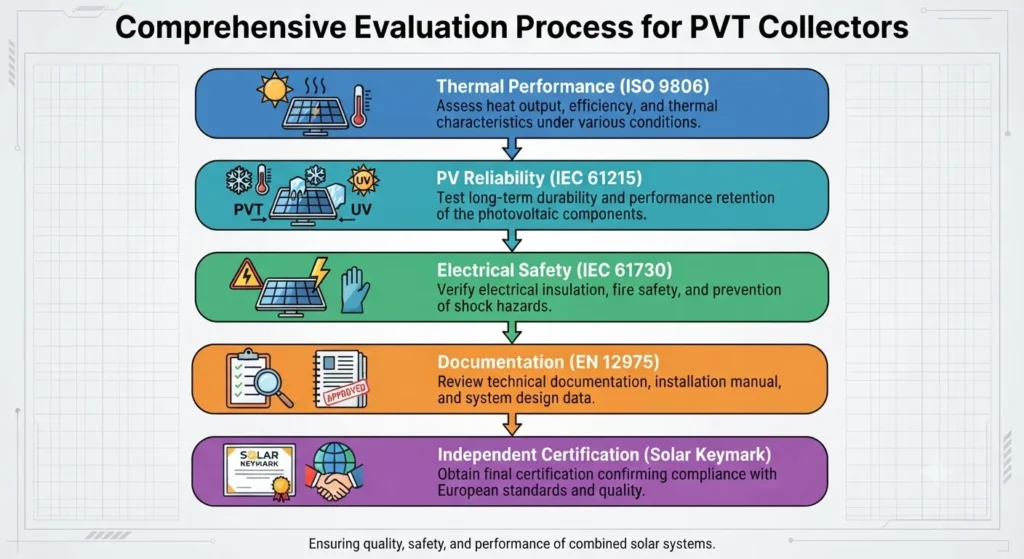
evaluation process of pvt (photovoltaic thermal) collector 转换自 png

Figure 1: Need to evaluate a PVT collector–Thermal performance?–ISO 9806–PV reliability?–IEC 61215–Electrical safety?–IEC 61730–Documentation?–EN 12975–Independent certification?–Solar Keymark

Engineering Takeaway

A professional PVT evaluation combines several international standards because each one addresses a different aspect of product performance, safety, and reliability.

ISO 9806 — The Core Standard for Thermal Collector Testing

Quick Summary

For liquid PVT collectors, ISO 9806 is the most important engineering standard because it defines how laboratory testing must be performed.

It standardizes the testing methodology rather than setting minimum performance requirements.


Engineering Note

ISO 9806 does not specify that a collector must achieve a particular efficiency.

Instead, it specifies:

  • laboratory procedures
  • environmental conditions
  • measurement methods
  • calculation methods
  • reporting requirements

This allows collectors from different manufacturers to be compared fairly.


Evidence Callout Box

Measured Evidence

The uploaded Intertek report includes:

  • thermal performance coefficients
  • pressure-drop measurements
  • incidence angle modifier (IAM)
  • measured operating data
  • engineering drawings
  • laboratory photographs
  • calibrated equipment records

all generated under the ISO 9806 testing framework.


What Does ISO 9806 Cover?

A complete ISO 9806 evaluation may include:

Thermal Performance

  • Optical efficiency (η₀)
  • Heat-loss coefficient (a₁)
  • Heat-loss coefficient (a₂)
  • Effective thermal capacity
  • Incidence Angle Modifier (IAM)

Hydraulic Performance

  • Pressure drop
  • Flow characteristics

Mechanical Testing

  • Mechanical load resistance
  • Pressure resistance

Environmental Testing

  • Thermal shock
  • Rain penetration
  • Exposure
  • Stagnation

Documentation

  • Test records
  • Measured data
  • Laboratory reporting

Engineering Comparison Table

ISO 9806 DefinesISO 9806 Does Not Define
Test methodsMinimum efficiency
Measurement proceduresProduct certification
Laboratory calculationsProduct ranking
Reporting formatMarket approval

Engineering Takeaway

When comparing two PVT collectors, engineers should first verify that both were tested according to ISO 9806 before comparing any performance values.

EN 12975 — Product Documentation and Engineering Requirements

Quick Summary

While ISO 9806 focuses on laboratory testing, EN 12975 complements it by defining the engineering documentation and product information that should accompany a solar thermal collector.

For designers and installers, complete documentation is as important as measured performance because it ensures the product can be installed, operated, and maintained safely throughout its service life.


Engineering Note

A collector may achieve excellent laboratory performance, but without proper installation instructions, operating limits, and product identification, engineering risk remains unnecessarily high.

Engineering quality therefore depends on both:

  • verified laboratory performance
  • complete technical documentation

Evidence Callout Box

Measured Data

The uploaded Intertek report includes a dedicated assessment of Label and Installer Instruction Manual according to EN 12975:2022 Clauses 6.2 and 6.3. The report concludes that the collector labeling and installation manual were checked against these requirements.


What Information Does EN 12975 Require?

According to EN 12975, a collector should provide engineering information including:

Product Identification

  • Manufacturer
  • Model designation
  • Serial number
  • Production year

Operating Limits

  • Maximum operating pressure
  • Maximum operating temperature
  • Mechanical load limits
  • Standard stagnation temperature

Installation Information

  • Collector dimensions
  • Weight
  • Mounting procedure
  • Hydraulic connection guidance
  • Recommended tilt angle
  • Transport and handling instructions

Maintenance Information

  • Cleaning recommendations
  • Maintenance requirements
  • Lightning protection recommendations
  • Airflow requirements
  • Climate class

These requirements improve installation quality and reduce field failures by ensuring that installers and engineers have access to complete technical information.


Engineering Comparison Table

ISO 9806EN 12975
Laboratory testingEngineering documentation
Performance measurementInstallation guidance
Thermal & hydraulic evaluationProduct labeling
Test methodologyUser and installer information

Engineering Takeaway

Engineering documentation should be evaluated alongside laboratory performance. A complete technical package reduces installation errors, simplifies maintenance, and improves long-term project reliability.


IEC 61215 and IEC 61730 — Why the PV Module Also Needs Its Own Standards

Quick Summary

A liquid PVT collector incorporates a photovoltaic module. Although the thermal section is evaluated according to ISO 9806, the PV module itself should also comply with internationally recognized photovoltaic standards.

These standards address aspects that fall outside the scope of ISO 9806, particularly long-term electrical performance and safety.


Engineering Note

ISO 9806 evaluates the collector as a thermal product.

It does not replace the electrical qualification and safety standards developed specifically for photovoltaic modules.


Evidence Callout Box

Measured Data

The Intertek report notes that the photovoltaic modules used in the tested collector had previously obtained TÜV certification, providing additional evidence that the PV component had been evaluated under the relevant photovoltaic certification framework before integration into the PVT collector.

IEC 61215

IEC 61215 evaluates the long-term durability of crystalline photovoltaic modules through environmental and mechanical qualification testing.

Typical evaluation areas include:

  • Thermal cycling
  • Humidity resistance
  • Mechanical loading
  • Electrical performance stability
  • Outdoor durability

Its objective is to demonstrate that the PV module can continue generating electricity reliably throughout its intended service life.


IEC 61730

IEC 61730 focuses on electrical safety.

It evaluates:

  • Electrical insulation
  • Shock protection
  • Fire safety considerations
  • Electrical construction
  • Safety under normal operating conditions

Together, IEC 61215 and IEC 61730 provide confidence that the electrical portion of the PVT collector has been evaluated according to internationally accepted photovoltaic requirements.


Engineering Comparison Table

StandardPrimary Purpose
ISO 9806Thermal collector testing
EN 12975Product documentation
IEC 61215PV module durability
IEC 61730PV electrical safety

Engineering Takeaway

A PVT collector combines thermal and photovoltaic technologies. Evaluating both subsystems against their respective international standards provides a more complete understanding of product performance and reliability.

Solar Keymark — Independent Certification for the European Market

Quick Summary

Solar Keymark is one of the most widely recognized voluntary certification schemes for solar thermal collectors in Europe. Unlike ISO 9806, which defines laboratory testing methods, Solar Keymark confirms that a product has successfully completed an independent certification process supported by accredited test results and factory quality assessment.

For engineering projects across Europe, Solar Keymark is frequently requested because it increases confidence that the product being delivered is consistent with the product that was tested.


Engineering Note

A common misunderstanding is that Solar Keymark is another laboratory test.

It is not.

Solar Keymark is a certification scheme.

Laboratory testing is only one part of the certification process.

Certification also considers:

  • laboratory evidence
  • manufacturing consistency
  • factory inspection
  • quality control
  • surveillance audits

Evidence Callout Box

Standard Requirement

The Solar Keymark Scheme generally requires:

  • Independent laboratory testing
  • Compliance with applicable European standards
  • Factory quality assessment
  • Ongoing production surveillance

Unlike a one-time laboratory test, certification continues throughout the product’s commercial life.


Why Engineers Prefer Certified Products

Certification reduces engineering uncertainty.

Instead of relying solely on a manufacturer’s declaration, engineers receive evidence that:

  • testing was independently performed
  • documentation has been reviewed
  • production quality is monitored
  • certified products remain consistent over time

For public projects and commercial buildings, this additional confidence often simplifies technical approval.


Engineering Comparison Table

ISO 9806Solar Keymark
Test methodCertification scheme
Generates measured dataReviews independent evidence
One laboratory evaluationContinuous certification process
No factory auditIncludes factory surveillance
Technical measurementsMarket confidence

Decision Tree

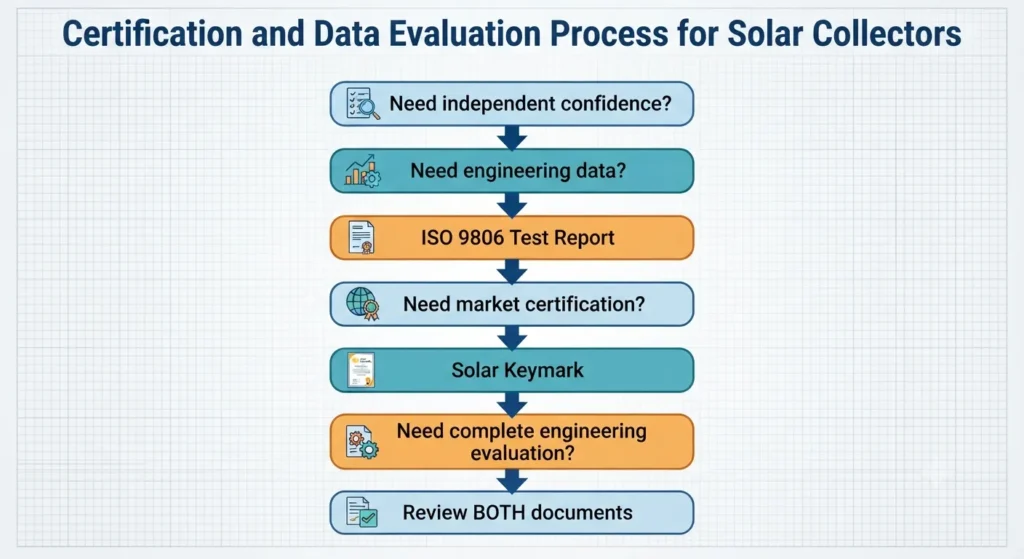
certification and data evaluation process for solar collectors

Figure 2: Need independent confidence?–Need engineering data?–ISO 9806 Test Report–Need market certification?–Solar Keymark–Need complete engineering evaluation?–Review BOTH documents

Engineering Takeaway

A Solar Keymark certificate should never replace the laboratory report.

Professional engineering evaluation always benefits from reviewing both the certification and the supporting test report.

How Engineers Verify That a PVT Collector Is Truly Tested

Quick Summary

Professional engineers do not simply ask whether a product has been tested.

Instead, they verify how, where, according to which standard, and what evidence is available.

This systematic review minimizes procurement risk and ensures technical decisions are based on verifiable information.


Engineering Note

The most reliable question is not:

“Is your product certified?”

It is:

“Can you provide the complete engineering evidence supporting your certification?”

The quality of the answer often reveals the maturity of the manufacturer.


Evidence Callout Box

Measured Evidence

The uploaded Intertek report provides far more than summary conclusions.

It includes:

  • laboratory measurements
  • engineering terminology
  • raw measured data
  • collector drawings
  • collector photographs
  • pressure-drop curves
  • test equipment list
  • instrument calibration information
  • engineering definitions

These supporting records increase transparency and allow engineers to review how the reported results were obtained.


Engineering Verification Checklist

Before approving a PVT collector, engineers typically verify the following:

Testing

  • Was testing performed by an independent laboratory?
  • Which standards were applied?
  • Is the report complete?

Performance Data

  • Thermal efficiency coefficients
  • Pressure-drop characteristics
  • Mechanical performance
  • Environmental testing

Documentation

  • Installation manual
  • Technical datasheet
  • Product labeling
  • Hydraulic drawings

Traceability

  • Report number
  • Test date
  • Product model
  • Laboratory identity

Manufacturing

  • Certification
  • Factory quality control
  • Product consistency

Engineering Comparison Table

QuestionStrong EvidenceWeak Evidence
Has the product been tested?Independent reportMarketing brochure
Is performance verified?Measured laboratory dataEstimated values
Is installation supported?Complete manualLimited instructions
Can results be traced?Report number & test recordsNo traceable evidence

Engineering Takeaway

Reliable engineering decisions are based on traceable evidence, not promotional statements.

Independent documentation allows every important technical claim to be verified.


Engineering Evidence Hierarchy

Quick Summary

Not every technical document carries the same evidential weight.

Professional engineers prioritize documents according to their technical reliability.


Engineering Comparison Table

PriorityEngineering EvidenceReliability
1Independent Test Report★★★★★
2International Standards★★★★★
3Certification Documents★★★★☆
4Installation Manual★★★★☆
5Product Datasheet★★★☆☆
6Marketing Material★☆☆☆☆

Engineering Takeaway

Whenever multiple sources are available, engineering decisions should always begin with independently measured evidence before considering summaries or promotional material.


Download Section

Recommended engineering documents for this topic:

  • Intertek ISO 9806 Test Report
  • Product Technical Datasheet
  • Installation Manual
  • Hydraulic Connection Drawings
  • Solar Keymark Certificate (where applicable)
  • PV Module TÜV / IEC Certification Documents

Related Guides

Continue reading within the Testing, Standards & Certification cluster:

Related Topic Guides

  • Testing Standards & Certification Framework
  • Thermal Performance Testing
  • Hydraulic Performance Testing
  • Mechanical Reliability Testing
  • Safety & Documentation

Related Intent Guides

  • What Is ISO 9806?
  • Is EN 12975 Still Relevant?
  • Why Are Independent Tests More Reliable Than Datasheets?
  • What Does an Intertek Test Report Prove?

Frequently Asked Questions

For thermal performance evaluation, ISO 9806 is the primary international testing standard because it defines standardized laboratory procedures for measuring collector performance.

No.

ISO 9806 specifies how testing is performed.

Certification is handled separately through schemes such as Solar Keymark or other certification bodies.

A PVT collector combines a thermal collector and a photovoltaic module.

Different standards evaluate:

  • thermal performance
  • documentation
  • PV durability
  • electrical safety
  • certification

Together they provide a comprehensive engineering assessment.

A laboratory report documents:

  • testing methodology
  • measured data
  • environmental conditions
  • instrumentation
  • engineering conclusions

This transparency allows engineers to verify technical claims objectively.