
Testing Standards & Certification Framework for PVT Collectors

Executive Summary

Selecting a PVT collector should never be based solely on a manufacturer’s datasheet. Professional engineering projects require independently verified evidence demonstrating that the collector has been evaluated using internationally recognized testing methods.

This handbook explains the complete testing and certification framework used for liquid PVT collectors, including ISO 9806, EN 12975, Solar Keymark, and related photovoltaic standards. It also shows how independent laboratory reports provide engineering evidence that supports collector selection, project approval, and system design.

Using the Solis PVT Intertek Test Report as a practical example, this guide distinguishes between measured laboratory data, standard requirements, engineering judgement, and best engineering practice, enabling readers to interpret test reports with confidence rather than relying on marketing claims.

Evidence Classification

Evidence TypeSource Used in This Article
Measured DataIntertek Test Report
Standard RequirementsISO 9806, EN 12975, Solar Keymark Scheme Rules
Engineering JudgementPVT system engineering and heat pump integration principles
Best PracticeEuropean engineering procurement and specification workflow

Why Testing Standards Matter

Quick Summary

International testing standards provide a common engineering language. They ensure that performance data from different manufacturers are measured using consistent methods, making technical comparisons objective and repeatable.

Engineering Note

A performance value is meaningful only when the testing methodology is known.

For example, stating that a collector has “80% efficiency” has little engineering value unless the report also specifies:

  • Which standard was used
  • Test conditions
  • Solar irradiance
  • Fluid temperature
  • Flow rate
  • Calculation method

Without this information, two published efficiency values may not be directly comparable.

Evidence Callout Box

Measured Evidence

The Solis PVT collector family was independently tested by Intertek under Report.

The report identifies the applicable testing standards, documents laboratory procedures, records measured operating data, and includes supporting drawings, photographs, equipment calibration records, and engineering conclusions.

Why Engineers Require Standardized Testing

Engineering decisions influence:

  • system efficiency
  • equipment sizing
  • operational reliability
  • project approval
  • warranty risk
  • long-term investment

Because these decisions involve significant technical and financial consequences, engineers require performance data that can be independently verified.

International standards provide this consistency by defining:

  • laboratory procedures
  • instrumentation
  • calculation methods
  • environmental conditions
  • reporting requirements

Rather than allowing each manufacturer to choose its own testing methodology, standardized procedures ensure that products can be compared using the same engineering criteria.

Engineering Comparison Table

Without StandardsWith International Standards
Different test methodsIdentical laboratory procedures
Difficult product comparisonDirect engineering comparison
Marketing-oriented valuesMeasured technical data
Unknown accuracyRepeatable measurements
Higher procurement riskLower engineering risk

Decision Tree

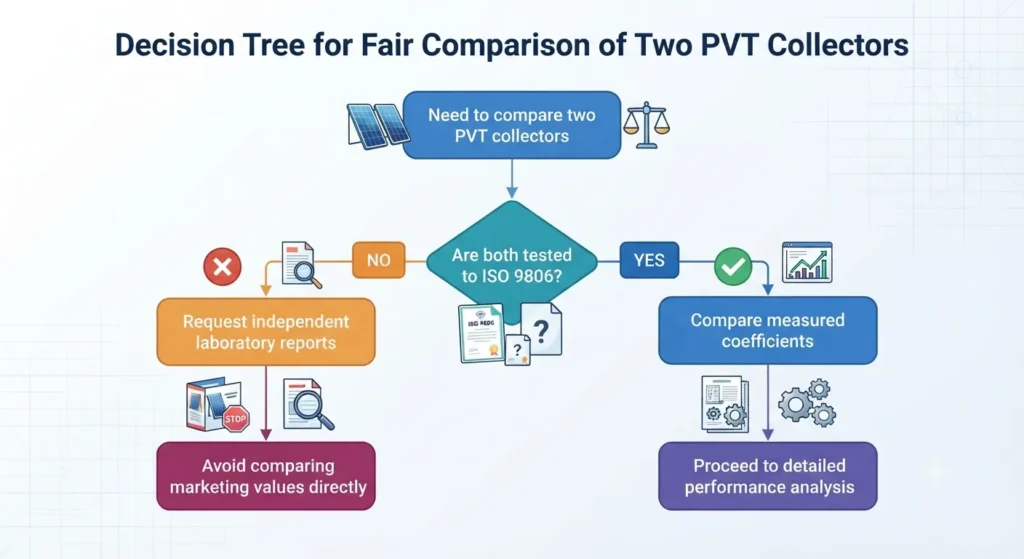
decision tree for fair comparison of two pvt collectors

Figure 1: Need to compare two PVT collectors–Are both tested to ISO 9806?–YES–Compare measured coefficients–NO–Request independent laboratory reports–Avoid comparing marketing values directly

Engineering Takeaway

Testing standards do not make a collector perform better.

They make performance measurable, repeatable, and comparable, allowing engineers to evaluate products using objective evidence instead of promotional claims.

The Three Levels of Engineering Validation

Quick Summary

Professional product validation consists of three distinct levels:

  1. Testing
  2. Certification
  3. Engineering application

Understanding the difference prevents many common procurement mistakes.

Level 1 — Laboratory Testing

Laboratory testing answers one question:

How does the collector perform under standardized conditions?

Testing measures characteristics such as:

  • thermal efficiency
  • pressure drop
  • mechanical resistance
  • stagnation behaviour
  • thermal shock resistance
  • environmental durability

These measurements produce engineering data.

Testing itself does not certify the product.

Level 2 — Certification

Certification answers a different question:

Has an independent organization confirmed that the product satisfies defined technical requirements?

Certification schemes review:

  • laboratory reports
  • manufacturing quality
  • product documentation
  • factory consistency
  • surveillance requirements

Examples include:

  • Solar Keymark
  • TÜV certification
  • other recognized conformity assessment schemes

Certification relies on laboratory testing but is not the same process.

Level 3 — Engineering Application

The final step occurs after testing and certification.

Engineers use verified data for:

  • collector selection
  • hydraulic calculations
  • heat pump integration
  • structural design
  • procurement evaluation
  • energy simulation

Testing provides the evidence.

Engineering converts that evidence into practical system design.

Engineering Comparison Table

Laboratory TestingCertificationEngineering Design
Measures performanceConfirms complianceApplies measured data
Generates technical dataReviews evidenceOptimizes system
Conducted by laboratoryConducted by certification bodyConducted by engineer
Produces test reportProduces certificateProduces project design

Evidence Callout Box

Engineering Evidence

The Intertek report contains:

  • measured thermal performance
  • hydraulic performance
  • mechanical evaluations
  • drawings
  • laboratory photographs
  • calibrated equipment records
  • measured operating data

These engineering records form the technical evidence used to support certification and engineering analysis.

Engineering Note

One of the most common misconceptions in renewable energy projects is assuming that a certificate replaces a test report.

It does not.

A certificate confirms compliance.

A laboratory report explains why the product complies by presenting the measured engineering evidence.


Engineering Takeaway

Always request both:

  • the certification document
  • the supporting laboratory report

The certificate confirms compliance.

The laboratory report provides the engineering data required for design, comparison, and procurement.

ISO 9806 — The Foundation of PVT Collector Performance Testing

Quick Summary

ISO 9806 is the internationally recognized standard that specifies how solar thermal collectors—including liquid PVT collectors—must be tested. It standardizes laboratory procedures but does not define minimum performance requirements or certify products.

For engineers, ISO 9806 provides the common framework that makes performance data from different manufacturers directly comparable.


Engineering Note

One of the most common misunderstandings is:

“ISO 9806 is a certification.”

This is incorrect.

ISO 9806 is a test method standard.

It tells accredited laboratories:

  • what to measure
  • how to measure it
  • acceptable measurement uncertainty
  • calculation methods
  • reporting requirements

It does not specify that a collector must achieve a particular efficiency value.


Evidence Callout Box

Standard Requirement

ISO 9806:2017

Defines standardized laboratory test methods for liquid solar thermal collectors, including thermal performance, hydraulic characteristics, mechanical durability, environmental resistance, stagnation behaviour, and reporting procedures.

What Does ISO 9806 Actually Test?

ISO 9806 evaluates much more than thermal efficiency.

A complete laboratory evaluation may include:

Thermal Performance

  • Optical efficiency (η₀)
  • Heat-loss coefficient a₁
  • Heat-loss coefficient a₂
  • Effective thermal capacity
  • Incidence Angle Modifier (IAM)
  • Power output curves

Hydraulic Performance

  • Flow rate
  • Pressure drop
  • Hydraulic characteristics

Mechanical Reliability

  • Mechanical loading
  • Structural integrity
  • Pressure resistance

Environmental Durability

  • Thermal shock
  • Rain penetration
  • Outdoor exposure
  • Stagnation
  • Freeze-related evaluations (where applicable)

Documentation Review

  • Product identification
  • Installation instructions
  • Technical documentation

Engineering Comparison Table

CategoryTypical Parameters
Thermalη₀, a₁, a₂, IAM, power curves
HydraulicPressure drop, flow rate
MechanicalLoad resistance, pressure strength
EnvironmentalThermal shock, stagnation, weather resistance
DocumentationLabels, manuals, technical data

How ISO 9806 Improves Engineering Accuracy

Without ISO 9806:

Every manufacturer could:

  • choose different irradiance
  • choose different flow rate
  • use different efficiency equations
  • publish different reference areas

As a result:

Efficiency values would become almost impossible to compare.

ISO 9806 removes this uncertainty.

Every accredited laboratory follows the same engineering procedures, allowing:

  • consultants
  • EPC contractors
  • engineering firms
  • procurement teams

to compare products using identical methodologies.


Evidence Callout Box

Measured Evidence

The Solis PVT collector family was tested according to ISO 9806:2017.

The report includes:

  • measured operating conditions
  • thermal performance coefficients
  • hydraulic measurements
  • engineering drawings
  • laboratory photographs
  • calibrated measuring instruments
  • measured raw operating data

rather than estimated manufacturer values.

Decision Tree

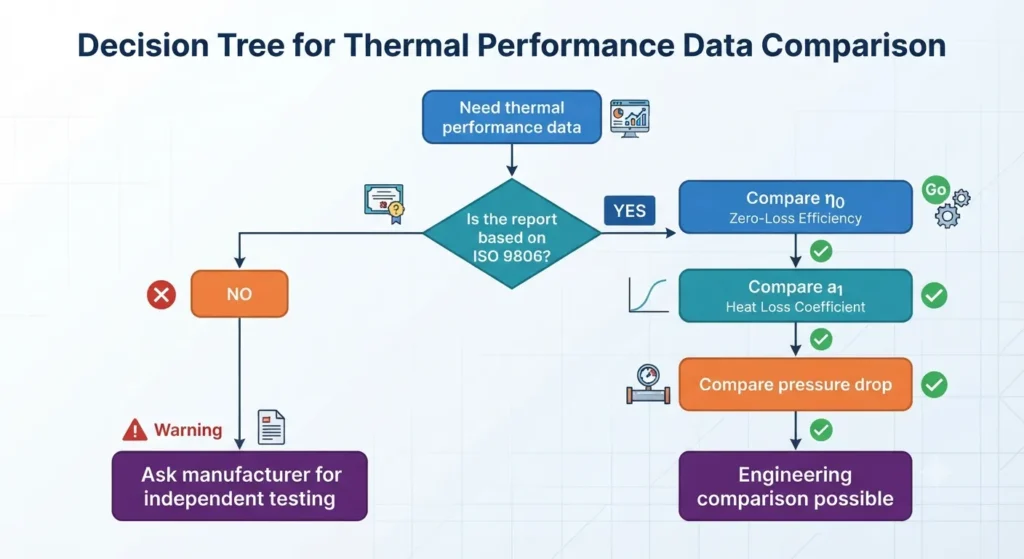
decision tree for thermal performance data comparison

Figure 2: Need thermal performance data–Is the report based on ISO 9806?–YES–Compare η₀–Compare a₁–Compare pressure drop–Engineering comparison possible–NO–Ask manufacturer for independent testing

Engineering Takeaway

ISO 9806 allows engineers to compare collectors using measured engineering data instead of marketing specifications.

It is the foundation upon which meaningful collector comparison is built.

EN 12975 — Product Requirements Beyond Laboratory Performance

Quick Summary

While ISO 9806 focuses on testing methodology, EN 12975 addresses the broader requirements needed to place a solar thermal collector into engineering practice.

It covers areas such as:

  • product identification
  • installation documentation
  • operating limits
  • safety information
  • technical labeling

Together, ISO 9806 and EN 12975 provide both performance evidence and engineering documentation.


Engineering Note

A collector can perform well in laboratory testing but still create installation risks if documentation is incomplete.

Engineering quality therefore includes both:

  • verified performance
  • complete technical documentation

Evidence Callout Box

Measured Evidence

The Intertek assessment reviewed the Solis PVT collector against the documentation requirements specified by EN 12975:2022, including product marking and installation documentation.

Why Documentation Matters

Documentation supports every stage of a project’s lifecycle.

From design through maintenance, engineers rely on technical documents to ensure that products are applied correctly.

Typical documents include:

  • installation manuals
  • hydraulic connection drawings
  • operating instructions
  • maintenance guidance
  • product labels
  • technical datasheets

Without this information:

Installation errors become more likely.

Maintenance becomes more difficult.

Engineering review becomes slower.


Typical EN 12975 Documentation Requirements

A professional documentation package should clearly define:

Product Information

  • manufacturer
  • model number
  • serial number
  • collector dimensions

Operating Limits

  • maximum operating pressure
  • operating temperature
  • installation angle
  • allowable mechanical load

Installation Guidance

  • mounting requirements
  • hydraulic connections
  • transport instructions
  • commissioning procedures

Maintenance Information

  • inspection intervals
  • servicing recommendations
  • operating precautions

Engineering Comparison Table

ISO 9806EN 12975
Test methodsProduct requirements
Laboratory measurementsEngineering documentation
Performance evaluationInstallation guidance
Thermal & hydraulic dataLabels & manuals
Engineering evidenceEngineering implementation

Engineering Note

Think of the two standards this way:

ISO 9806 answers:

How does the collector perform?

EN 12975 answers:

How should the collector be identified, installed, and used?

Both are required for professional engineering projects.


Engineering Takeaway

A complete engineering evaluation requires both:

  • independently measured performance
  • complete technical documentation

Neither should be considered sufficient on its own.

Solar Keymark — Independent Certification for the European Market

Quick Summary

While ISO 9806 defines how a PVT collector is tested, Solar Keymark demonstrates that the product has passed an independent certification process based on recognized standards and ongoing quality control.

For many European heating projects, Solar Keymark is one of the most widely recognized voluntary certification schemes for solar thermal products.

It provides additional confidence that laboratory test results are supported by factory quality assurance and continuous surveillance.


Engineering Note

Many engineers incorrectly assume:

Solar Keymark = another laboratory test.

In reality:

Solar Keymark is not a test method.

It is a product certification scheme.

The certification body reviews evidence generated from accredited laboratory testing together with manufacturing quality assessments.


Evidence Callout Box

Standard Requirement

Solar Keymark certification generally requires:

  • Accredited laboratory testing
  • Compliance with applicable standards
  • Factory inspection
  • Quality management review
  • Periodic surveillance

Certification is therefore based on a combination of product performance and manufacturing consistency rather than a single laboratory measurement.

How Solar Keymark Works

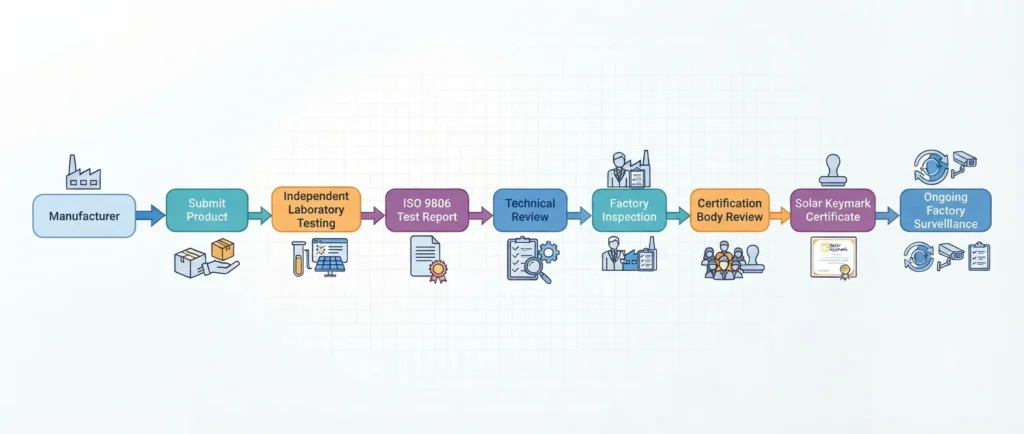
A simplified certification workflow is shown below.

Solar Keymark Workflow

solar keymark certification workflow

Figure 3: Manufacturer–Submit Product–Independent Laboratory Testing–ISO 9806 Test Report–Technical Review–Factory Inspection–Certification Body Review–Solar Keymark Certificate–Ongoing Factory Surveillance

Unlike a one-time laboratory test, Solar Keymark includes continuous quality monitoring to help ensure that products manufactured after certification remain consistent with the tested design.

Why Solar Keymark Matters for Engineers

For consulting engineers and EPC contractors, Solar Keymark offers several practical advantages.

It provides confidence that:

  • laboratory testing was independently performed
  • product documentation has been reviewed
  • manufacturing processes have been assessed
  • certified products continue to be monitored

This can simplify product evaluation during:

  • public tenders
  • commercial building projects
  • district heating systems
  • renewable heating programs
  • government incentive schemes

Engineering Comparison Table

ISO 9806Solar Keymark
Test method standardCertification scheme
Defines laboratory proceduresReviews testing evidence
Generates engineering dataConfirms independent compliance
One laboratory evaluationOngoing certification process
No factory inspectionIncludes factory surveillance

Engineering Note

Solar Keymark does not replace the laboratory report.

Professional engineers often request both:

  • Solar Keymark Certificate
  • Supporting ISO 9806 Test Report

The certificate confirms compliance.

The report provides the engineering data required for design calculations.


Engineering Takeaway

Solar Keymark adds an additional layer of confidence by combining standardized laboratory testing with independent certification and manufacturing surveillance.

For many European projects, it significantly strengthens product credibility during specification and procurement.

Why PVT Collectors Also Require Photovoltaic Standards

Quick Summary

A liquid PVT collector is fundamentally different from a conventional solar thermal collector because it combines two energy technologies within one product.

As a result, engineers should evaluate both the thermal collector and the photovoltaic module, each according to the standards that apply to its function.


Engineering Note

One common misunderstanding is that ISO 9806 evaluates the entire PVT collector, including long-term PV module reliability.

It does not.

ISO 9806 focuses on the thermal collector.

The photovoltaic component is typically assessed using dedicated PV standards.


Evidence Callout Box

Measured Evidence

The Intertek report identifies that the photovoltaic modules incorporated into the tested Solis PVT collectors had already obtained TÜV certification before integration into the complete collector assembly.

This demonstrates that the PV component and the thermal collector were evaluated within their respective technical frameworks.

IEC 61215 — PV Module Reliability

IEC 61215 is the internationally recognized qualification standard for crystalline photovoltaic modules.

It evaluates long-term reliability through tests such as:

  • thermal cycling
  • humidity exposure
  • mechanical loading
  • electrical performance stability
  • environmental durability

Its objective is to demonstrate that PV modules can maintain reliable electrical performance during long-term outdoor operation.

IEC 61730 — Electrical Safety

While IEC 61215 focuses on durability, IEC 61730 addresses electrical safety.

Typical evaluation areas include:

  • insulation
  • electrical protection
  • fire safety considerations
  • shock protection
  • electrical construction requirements

Together, IEC 61215 and IEC 61730 provide complementary evidence regarding the photovoltaic portion of a PVT collector.


Engineering Comparison Table

StandardPrimary FocusTypical Application
ISO 9806Thermal collector testingThermal performance and durability
EN 12975Product documentationInstallation and product requirements
IEC 61215PV reliabilityLong-term photovoltaic performance
IEC 61730Electrical safetyElectrical safety compliance
Solar KeymarkProduct certificationIndependent market certification

Why Multiple Standards Are Necessary

A PVT collector performs two different functions simultaneously:

Thermal Function

Captures solar heat and transfers it to a circulating fluid.

Evaluated primarily by:

  • ISO 9806
  • EN 12975

Electrical Function

Generates photovoltaic electricity.

Evaluated primarily by:

  • IEC 61215
  • IEC 61730

Because these functions involve different engineering disciplines, no single international standard can comprehensively evaluate every aspect of product performance.

Instead, engineers should review evidence from the standards most relevant to each subsystem.


Engineering Note

When specifying a PVT collector, avoid asking:

“Is this product certified?”

Instead, ask:

“Which components have been evaluated, according to which standards, and by whom?”

This produces a much clearer understanding of the available engineering evidence.


Engineering Takeaway

A professional PVT evaluation combines evidence from multiple standards rather than relying on a single certificate.

Understanding the role of each standard enables engineers to assess the product more comprehensively and make more informed specification decisions.

How Engineers Build a Complete Testing & Certification Framework

Quick Summary

Professional engineering decisions are never based on a single document.

Instead, engineers build an evidence chain, combining laboratory test reports, applicable international standards, certification documents, and engineering judgement to determine whether a PVT collector is suitable for a specific project.

This approach reduces technical uncertainty and improves procurement confidence.


Engineering Note

A common procurement mistake is asking:

“Does this product have a certificate?”

A better engineering question is:

“Can the manufacturer provide sufficient evidence to demonstrate performance, reliability, compliance, and engineering suitability?”

The second question leads to a much more robust technical evaluation.


Evidence Callout Box

Best Practice

Professional consulting engineers generally review evidence in the following order:

  1. Independent laboratory test reports
  2. Applicable international standards
  3. Certification documents
  4. Technical documentation
  5. Engineering support capability

This sequence ensures that engineering decisions are based on objective technical evidence before commercial considerations.


Engineering Evidence Hierarchy

Not all technical documents carry the same evidential value.

The following hierarchy is recommended when evaluating a PVT collector.

PriorityEvidencePrimary Purpose
Level 1Independent Laboratory Test ReportDemonstrates measured performance
Level 2International StandardsDefines testing methodology and engineering requirements
Level 3CertificationConfirms compliance through an independent certification scheme
Level 4Technical DocumentationSupports design, installation, and maintenance
Level 5Manufacturer DatasheetSummarizes key technical characteristics
Level 6Marketing MaterialIntroduces products and applications

Engineering Comparison Table

DocumentEngineering ValueProcurement Value
Independent Test Report★★★★★★★★★★
ISO / EN Standards★★★★★★★★★☆
Solar Keymark Certificate★★★★☆★★★★★
Installation Manual★★★★☆★★★★☆
Product Datasheet★★★☆☆★★★★☆
Marketing Brochure★☆☆☆☆

★★☆☆☆

Decision Tree

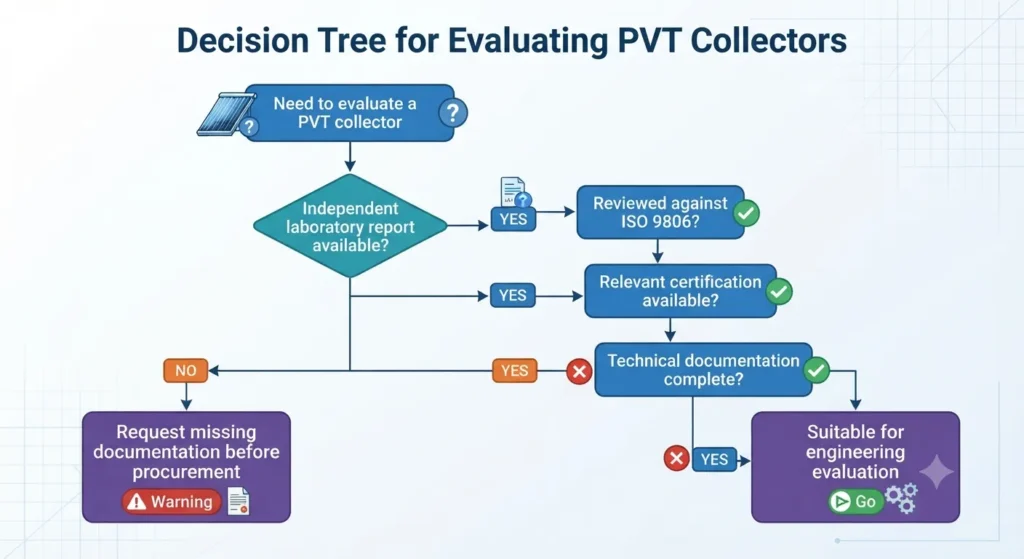
decision tree for evaluating pvt collectors

Figure 4: Need to evaluate a PVT collector–Independent laboratory report available?–YES–Reviewed against ISO 9806?–YES–Relevant certification available?–YES–Technical documentation complete?–YES–Suitable for engineering evaluation–NO–Request missing documentation before procurement

Engineering Takeaway

The strongest engineering decisions are supported by a complete body of evidence rather than by any single document.

Testing, standards, certification, and technical documentation should be evaluated together.

Download Section

The following engineering documents are recommended when specifying or evaluating a liquid PVT collector.

DocumentEngineering Purpose
Intertek Test ReportIndependent performance verification
Product DatasheetTechnical specifications
Installation ManualInstallation and commissioning
Hydraulic DrawingsSystem integration
Mechanical DrawingsStructural design
Solar Keymark Certificate Certification evidence
TÜV Certificate (PV module)Photovoltaic compliance

Engineering Recommendation: Always request the complete technical package rather than relying solely on a product brochure or datasheet.

Frequently Asked Questions

Is ISO 9806 a certification?

No. ISO 9806 is an international test method standard. It defines how solar thermal collectors should be evaluated in a laboratory but does not certify products or specify minimum efficiency requirements.

What is the difference between ISO 9806 and EN 12975?

ISO 9806 specifies laboratory testing procedures for evaluating collector performance. EN 12975 focuses on broader product requirements, including technical documentation, product marking, installation guidance, and engineering information. Together, they provide complementary evidence for engineering evaluation.

Does Solar Keymark replace the laboratory test report?

No. Solar Keymark is a certification scheme that relies on accredited laboratory testing. The certification confirms compliance, while the laboratory report contains the detailed engineering measurements used during product evaluation.

Why should engineers request an independent laboratory report?

Independent laboratory reports provide transparent, standardized, and repeatable engineering evidence. Unlike marketing material, they document the testing methods, measured performance, environmental conditions, and technical conclusions required for engineering design and procurement.

Can products tested to the same standard be compared directly?

Generally, yes. One of the primary purposes of standards such as ISO 9806 is to establish consistent testing methods so that performance data from different manufacturers can be compared under equivalent laboratory conditions. However, engineers should compare the complete set of measured parameters rather than relying on a single efficiency value.

Engineering Support for PVT Projects

Selecting a PVT collector involves much more than comparing efficiency figures.

At Solis PVT, we support engineers, consultants, and system designers with independently verified performance data, technical documentation, and application guidance for heat pump integration.

Whether you are evaluating products, comparing thermal performance, or designing a renewable heating system, our engineering team can help you interpret laboratory results and identify the most suitable solution for your project.