
Covered vs Uncovered PVT Collectors: Which Design Is Better for a PVT Heat Pump System?
Solis PVT Engineering Design Series
A technical authority website that helps engineers design real PVT heat pump systems.
Published: Sep. 8, 2026
Last Modified:Nov. 5, 2026
Introduction
PVT collectors combine photovoltaic electricity generation with the collection of thermal energy. However, not all PVT collectors manage heat in the same way.
One important design distinction is whether the collector has a transparent cover above the absorber and photovoltaic layer.
A covered PVT collector uses a transparent layer, typically glass, to reduce heat loss from the collector surface. An uncovered PVT collector exposes the PV and thermal collection surface directly to the surrounding environment.
This difference affects more than the collector’s thermal efficiency. It influences operating temperature, heat exchange with the environment, electrical output under different conditions, condensation management, construction complexity and the way the collector should be integrated into a heat-pump system.
Neither design is universally better.
The correct choice depends on the intended heat source, operating temperature range, climate, system configuration and the relative importance of thermal and electrical output.
This article compares the two designs from an engineering perspective.
1. What Is the Difference Between Covered and Uncovered PVT?
The main difference is the presence or absence of a transparent cover above the collector’s active surface.
1.1 Covered PVT collectors
A covered PVT collector generally includes:
A transparent front cover, commonly glass.
A photovoltaic layer.
A thermal absorber or heat exchanger.
Thermal insulation and a supporting structure.
Fluid connections for heat transfer.
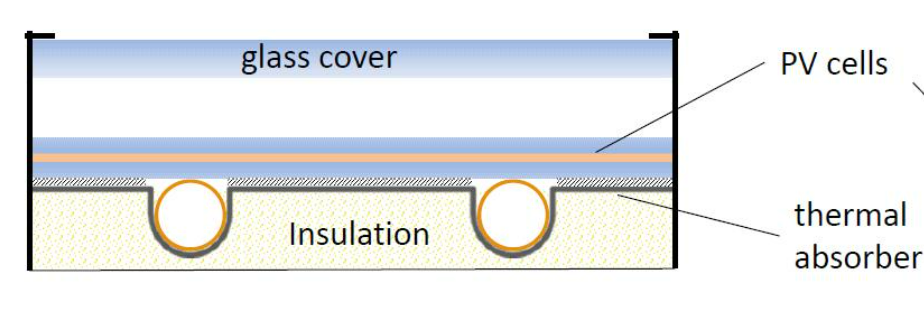
The transparent cover creates an additional layer between the collector surface and the outdoor environment.
It reduces convective heat exchange with ambient air and can reduce heat loss from the collector surface. The cover also changes the optical path of incoming solar radiation, so its optical properties and construction are important.
The actual performance depends on the complete collector design, including the cover’s transmittance, spacing, sealing, absorber configuration and insulation.
1.2 Uncovered PVT collectors
An uncovered PVT collector has no additional transparent cover above the active surface.
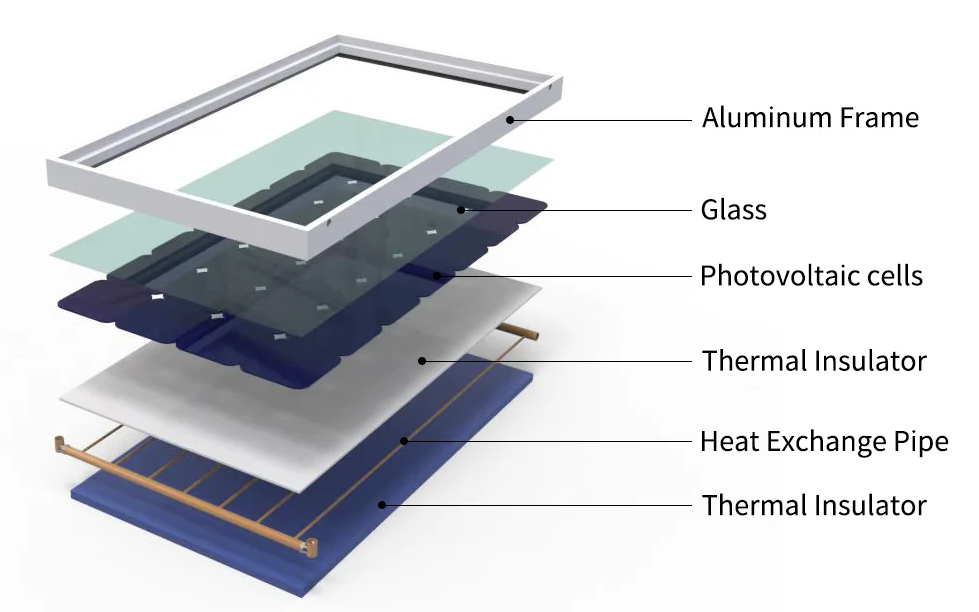
Its typical construction includes:
A photovoltaic module or laminate.
A thermal absorber or heat exchanger attached to the rear.
Thermal connections for a circulating fluid.
A supporting structure and, depending on the design, rear insulation.
Because the front surface is directly exposed to the environment, the collector exchanges heat with outdoor air through convection and with its surroundings through radiation.
This can be useful when the system is designed to collect low-temperature environmental heat, rather than relying exclusively on solar radiation.
1.3 Basic structural comparison
Design feature | Covered PVT | Uncovered PVT |
|---|---|---|
Transparent front cover | Yes | No additional cover |
Front-side heat loss | Generally reduced | Generally higher |
Thermal insulation effect | Cover adds a thermal resistance | Depends mainly on rear and edge construction |
Environmental heat exchange | More restricted | More direct |
Construction | Usually more complex | Often simpler |
Optical behaviour | Depends on cover transmittance and reflections | No additional cover-related optical loss |
Potential operating temperature | Better suited to retaining heat | Strongly influenced by ambient conditions and wind |
These are general design tendencies, not guaranteed performance rankings. Different collector constructions can produce different results.
2. How the Cover Changes Thermal Performance
The most important engineering effect of a transparent cover is its influence on heat transfer between the collector and the environment.
A PVT collector receives solar radiation and converts part of it into electricity. The remaining absorbed energy can contribute to thermal collection, while some energy is lost to the surrounding environment. A simplified thermal balance can be expressed as:

Where:
\(Q_{\mathrm{useful}}\) is the useful thermal energy collected.
\(Q_{\mathrm{absorbed}}\) is the solar energy absorbed by the collector.
\(Q_{\mathrm{electrical}}\) is the electrical energy generated.
\(Q_{\mathrm{loss}}\) is the heat lost to the environment.
The cover mainly influences the heat-loss term. It does not create additional solar energy.
2.1 Convective heat loss
An uncovered collector is directly exposed to outdoor air.
Wind can increase convective heat transfer from the collector surface, particularly when the collector temperature is higher than ambient temperature.
A simplified expression is:
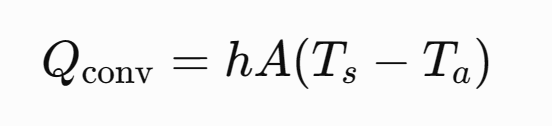
\(h\) is the convective heat-transfer coefficient.
\(A\) is the exposed surface area.
\(T_s\) is the surface temperature.
\(T_a\) is the ambient air temperature.
The coefficient \(h\) depends on environmental conditions, including wind speed, surface geometry and installation conditions.
A covered collector introduces an additional layer and an enclosed space. This can reduce direct convective heat loss from the absorber, although heat transfer still occurs through the cover and surrounding structure.
2.2 Radiative heat loss
The collector also exchanges long-wave thermal radiation with its surroundings.
The simplified radiative heat-transfer relationship is:

\[ Q_{\mathrm{rad}} = \varepsilon \sigma A (T_s^4-T_{\mathrm{sur}}^4) \]
\(\varepsilon\) is the effective emissivity.
\(\sigma\) is the Stefan–Boltzmann constant.
\(T_s\) is the surface temperature in kelvin.
\(T_{\mathrm{sur}}\) is the effective surrounding temperature in kelvin.
A transparent cover changes the radiative exchange between the absorber and the sky. The resulting heat loss depends on the optical and thermal properties of the cover and the temperatures of the different surfaces.
2.3 Why lower heat loss can matter
When the collector is intended to deliver heat at a relatively high temperature, reducing heat loss can help maintain a useful temperature difference between the collector and its surroundings.
This is one reason covered designs can be attractive for applications where the system needs to retain heat.
However, lower heat loss is not always the only objective.
A heat-pump source collector may benefit from absorbing heat from the surrounding air as well as from solar radiation. In that situation, restricting environmental heat exchange may not always be advantageous.
Engineering implication: The thermal behaviour must be evaluated against the intended operating mode, not simply by comparing the collector’s heat-loss characteristics.
3. Operating Temperature and Heat-Pump Applications
The collector’s operating temperature is one of the most important factors when selecting a PVT design.
A collector operating close to ambient temperature behaves differently from one operating significantly above ambient temperature.
3.1 Covered PVT: retaining useful heat
A covered PVT collector can reduce heat loss and support higher collector temperatures under suitable solar conditions.
This can be relevant when:
The system needs a higher-temperature thermal source.
Solar heat is intended to contribute directly to a heating circuit.
The design prioritises thermal retention.
The collector operates under conditions where heat loss would otherwise be significant.
However, a higher collector temperature does not automatically mean better overall heat-pump performance.
The heat pump’s source temperature, evaporating conditions, flow rate and control strategy must all be considered.
3.2 Uncovered PVT: exchanging heat with the environment
An uncovered PVT collector can exchange heat directly with ambient air.
Depending on the operating conditions, it may collect energy from:
Solar radiation.
Ambient air.
Long-wave radiation exchange with the surroundings.
A combination of these sources.
This makes uncovered collectors relevant to systems designed to use the PVT array as a low-temperature heat source.
For example, a collector connected to a brine circuit may absorb environmental heat when solar radiation is low, provided that the temperature difference and heat-transfer conditions are favourable.
The amount of heat collected depends on ambient temperature, wind, surface temperature, fluid temperature and collector construction.
3.3 Why the heat-pump source temperature matters
The heat pump does not simply receive a fixed amount of heat from the collector.
Its performance depends on the temperature lift between the heat source and the required heating temperature.
In general:
A higher source temperature can reduce the temperature lift required by the heat pump.
A lower source temperature can increase the temperature lift and may reduce the heat pump’s COP.
The collector must supply sufficient heat at the required operating conditions.
System controls must prevent unstable operation or excessive temperature variation.
Therefore, the relevant question is not simply whether the collector can reach a high temperature.
It is whether the collector can provide a suitable and reliable heat source for the heat pump over the expected operating period.
4. Electrical Performance: An Important Trade-Off
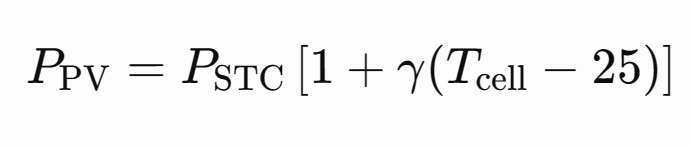
PVT collectors must be evaluated as combined electrical and thermal systems. Photovoltaic cell temperature affects electrical performance. In general, higher cell temperatures reduce PV power output. A simplified relationship is:
\[ P_{\mathrm{PV}} = P_{\mathrm{STC}} \left[ 1+\gamma(T_{\mathrm{cell}}-25) \right] \]
\(P_{\mathrm{PV}}\) is the estimated PV power at the operating cell temperature.
\(P_{\mathrm{STC}}\) is the rated power under standard test conditions.
\(\gamma\) is the PV power temperature coefficient.
\(T_{\mathrm{cell}}\) is the cell temperature in °C.
The actual calculation should use the module’s specified temperature coefficient and account for irradiance and other operating conditions.
4.1 Covered collector considerations
A cover can reduce heat loss from the collector, but it can also change the thermal environment around the PV cells.
Depending on the design, a covered collector may experience:
Higher cell temperatures under some operating conditions.
Additional optical losses from the cover.
Different ventilation and heat-transfer behaviour.
Different temperature distributions across the module.
The net electrical effect cannot be determined from the presence of glass alone.
4.2 Uncovered collector considerations
An uncovered collector has no additional transparent cover that reduces incoming solar transmission.
It is also directly exposed to ambient air, which can support cooling under suitable conditions.
However, the electrical benefit depends on the collector’s actual temperature and the effectiveness of its rear heat exchanger.
An uncovered collector can still operate at high temperatures if heat removal is insufficient or environmental conditions are unfavourable.
4.3 The correct comparison
Engineers should compare:
Electrical power at comparable irradiance and ambient conditions.
PV cell temperature.
Thermal output at the same fluid inlet and outlet conditions.
Total useful energy delivered by the system.
Heat-pump electricity consumption.
Auxiliary electricity consumption, including pumps and controls.
Comparing only the nominal PV power or the thermal efficiency of two collectors is not sufficient to determine which system performs better.
5. Environmental Heat Collection and Seasonal Operation
One of the important differences between covered and uncovered PVT collectors is how they interact with the environment.
This becomes particularly relevant in heat-pump systems operating outside peak solar hours.
5.1 Solar radiation is not the only possible heat source
An uncovered PVT collector can exchange heat with the surrounding air.
When the collector surface is colder than ambient air, heat may transfer from the air to the collector.
This can support heat collection during periods of low solar radiation, depending on the system’s operating temperatures and heat-transfer conditions.
The collector may also exchange long-wave radiation with the sky. This can produce either heat gain or heat loss depending on the temperature and radiative conditions.
5.2 Covered collectors and environmental exchange
A cover reduces direct interaction between the absorber and outdoor air.
This can be beneficial when the objective is to retain heat. However, it can also limit the collector’s ability to use ambient air as a heat source.
The cover does not eliminate environmental heat exchange. Heat can still transfer through the cover and other collector surfaces.
5.3 Seasonal performance must be assessed
The relative advantages of covered and uncovered PVT collectors may change throughout the year.
Operating condition | Covered PVT | Uncovered PVT |
|---|---|---|
Strong solar radiation | Can retain more absorbed heat, depending on design | Can collect solar heat while exchanging heat with ambient air |
Cold ambient conditions | Reduced front-side heat loss may be beneficial | Greater exposure to cold air can increase heat loss |
Warm ambient conditions | May limit direct air exchange | May benefit from ambient heat collection |
Low solar radiation | Performance depends on stored and available heat | May collect environmental heat if the collector is colder than ambient |
Windy conditions | Cover can reduce direct wind influence on the absorber | Wind can increase convective heat exchange |
This table describes tendencies rather than guaranteed outcomes.
A proper comparison requires hourly or sub-hourly weather data and a model of the collector’s thermal behaviour.